

Fybrance
Fibre Science for Formulation
Compare hydration, dispersion, viscosity and water binding under defined test conditions, then check performance in your formulation.
Properties and behaviour
- Hydration and Dispersion: Record wetting, dispersion and hydration separately when evaluating a fibre powder.
- Viscosity: Compare viscosity only when preparation, measurement conditions and reporting units are clear.
- Particle Size and Bulk Density: Use particle and density information to understand handling and preparation, without assuming that finer is better.
- Water Binding: Compare water-holding results through their methods and through the behaviour of the finished product.
- Fermentation, Tolerance and Evidence: Treat microbial fermentation, digestive tolerance and demonstrated health benefit as different questions.
- Process Stability: Evaluate fibre through the process and storage conditions of the finished food.
- Fibre Declaration and Analysis: Connect ingredient composition, finished-product testing and destination-market declaration requirements.
Use the modules to define an evaluation
These resources explain measurement and formulation questions. They do not imply that Fybrance has performed a particular test or owns the facilities described. Confirm the work, method and responsible organisation for your project.
Fermentation, Tolerance and Evidence
Treat microbial fermentation, digestive tolerance and demonstrated health benefit as different questions.
Fermentation alone does not establish a prebiotic claim. Product claims need evidence applicable to the material and intended use.
Separate fermentation evidence from consumption experience.
Fermentability concerns microbial use of a substrate. Tolerance concerns the experience of consuming a particular amount in a particular context. Laboratory fermentation results and human observations provide different kinds of evidence.
- Identify the fibre studied
- Check the study conditions
- Assess relevance to intended intake
What to record, and what it tells you.
Material identity
Check that the studied material matches the proposed ingredient.
Evidence for one material cannot be assumed to cover every fibre from the same source.
Study design
Distinguish laboratory fermentation work from human research.
A laboratory result does not establish a consumer benefit or tolerance claim.
Intake context
Record serving amount, frequency, study population and preparation.
Use the conditions actually studied when assessing relevance.
Keep the evidence levels separate
| Evidence | What it can address | What it does not establish by itself |
|---|---|---|
| Laboratory fermentation work | Behaviour under the stated experimental conditions. | A predictable response in every person. |
| Human tolerance assessment | Responses to the studied material, amount and conditions. | Universal comfort at any intake. |
| Relevant human outcome research | The outcome measured in the studied population and preparation. | The same benefit from a different grade or finished blend. |
Review the actual material and serving before transferring a study to a product.
Fibre Declaration and Analysis
Connect ingredient composition, finished-product testing and destination-market declaration requirements.
Agree method suitability with the laboratory and declaration requirements with the responsible regulatory reviewer.
Ingredient addition and measured dietary fibre are different quantities.
The weight of an ingredient added to a recipe is not necessarily the weight of dietary fibre declared on its label. Composition, analytical method and the finished-product basis must be considered together.
- Define the sample and market
- Agree the analytical method
- Review the finished-product result
What to record, and what it tells you.
Method scope
Ask the laboratory which fibre fractions the selected method measures.
Do not assume every method measures all resistant starches and oligosaccharides equally.
Reporting basis
Record moisture basis and whether the sample is sold dry or prepared.
Serving calculations must use a compatible basis.
Declaration review
Reconcile formulation records with laboratory findings and market requirements.
An ingredient supplier statement does not by itself approve a finished-product claim.
Ingredient weight is not the declared fibre value
For an illustrative calculation, 5 g of an ingredient at 80% fibre contributes 4 g of ingredient-derived fibre before other formulation and reporting considerations. This is not a grade specification or a claim threshold.
Agree the appropriate analytical approach with the laboratory and review the relevant market definition. The FDA reference provides a US example of why measured non-digestible carbohydrate and permitted fibre declaration are not automatically identical.
Hydration and Dispersion
Record wetting, dispersion and hydration separately when evaluating a fibre powder.
Report dispersibility separately from solubility and final viscosity. They describe different properties.
Wetting is not the same as dissolving.
Dispersion describes the distribution of particles through a liquid. Hydration describes their interaction with water. A powder may wet at its surface while retaining a dry centre; a uniformly dispersed fibre need not dissolve. This is ingredient behaviour during mixing, not bodily hydration.
- Contact with liquid
- Particle separation
- Hydration over time
What to record, and what it tells you.
Surface wetting
Observe floating powder and dry islands during addition.
A wet outer surface alone does not establish complete dispersion.
Persistent agglomerates
Examine remaining lumps after a fixed mixing period.
Distinguish trapped dry powder from a uniformly hydrated gel.
Mixing window
Record addition rate, mixing equipment and elapsed time.
A result from high-shear equipment may not transfer to spoon stirring.
A preparation record that can be repeated
| Record | Observation |
|---|---|
| Preparation conditions | Ingredient concentration, liquid temperature, addition sequence and mixing equipment. |
| During addition | Floating powder, wetting and visible dry islands. |
| After the defined mixing time | Remaining lumps and any dry centres. |
| After the defined holding time | Texture and viscosity development. |
Use the intended preparation method as one test condition. A high-shear laboratory result may not describe spoon stirring by a consumer.
Particle Size and Bulk Density
Use particle and density information to understand handling and preparation, without assuming that finer is better.
Finer material is not automatically better. The acceptable particle profile depends on the filling equipment and intended texture.
Particle distribution and powder packing are separate measurements.
A mesh description concerns particle size. Bulk density concerns the mass occupying a given powder volume, including the spaces between particles. Both help explain handling, but neither replaces the other in a material specification.
- Take a representative sample
- Measure size and density separately
- Relate results to handling
What to record, and what it tells you.
Distribution
Record the measurement method and the fractions or distribution reported.
A single nominal mesh value can hide a broad particle distribution.
Loose and tapped density
State how the sample was filled, settled or tapped.
Do not compare a loose-fill value with a tapped value as though they are equivalent.
Segregation
Inspect representative samples from different points in a blend or filling run.
An acceptable average does not establish uniformity throughout the batch.
Separate the measurements
For particle size, record the method and distribution rather than a single descriptive word. For bulk density, distinguish loose and tapped measurements and keep the preparation procedure consistent.
Connect the result to the application: dust, flow, filling, wetting and particle perception are different endpoints. A change that improves one can worsen another.
Process Stability
Evaluate fibre through the process and storage conditions of the finished food.
Stability in one process does not establish stability in another. Define which property must remain within the product target.
Compare the material before and after the actual process.
A powder specification does not describe every change during manufacturing. A process study tracks the properties relevant to the product through its heat, shear, acidity, drying or storage history.
- Establish a reference
- Apply the defined process
- Measure the relevant change
What to record, and what it tells you.
Exposure record
Record temperatures, holding times, pH and equipment conditions.
A process name alone does not describe the treatment received by the sample.
Matched comparison
Compare samples with known compositions and processing histories.
Recipe changes can otherwise be mistaken for a process effect.
Outcome selection
Choose relevant physical, sensory or compositional measurements.
Unchanged appearance does not establish unchanged fibre composition.
Compare before and after processing
Record the same relevant endpoints before and after the defined process: composition where needed, appearance, viscosity, texture or separation. Keep the control and trial preparation comparable.
State the process conditions and sample timing. A material’s generic description does not establish stability through every combination of heat, acidity, moisture and storage.
Viscosity
Compare viscosity only when preparation, measurement conditions and reporting units are clear.
Viscosity is not a direct measurement of gel strength, particle suspension or sensory acceptance.
A viscosity value needs measurement conditions.
Viscosity describes resistance to flow. An initial reading and a reading after standing can answer different formulation questions. Instrument settings and sample history belong with the result, not in a separate undocumented assumption.
- Prepare a defined concentration
- Measure under stated conditions
- Compare the time profile
What to record, and what it tells you.
Concentration basis
Record the ingredient concentration and whether it is reported on an as-supplied or dry basis.
Equal spoon volumes do not establish equal concentrations.
Instrument conditions
Record instrument, geometry or spindle, speed and temperature.
Readings from different methods are not automatically interchangeable.
Time and shear history
Record mixing, rest time and the point at which each reading is taken.
Compare the development of viscosity, not only a single final number.
Measurement reference: Brookfield viscosity measurement guidance.
Report enough information to compare results
| Field | Record |
|---|---|
| Sample and concentration | Material identity, lot and preparation basis. |
| Temperature and time | Measurement temperature and time after preparation. |
| Instrument conditions | Instrument, spindle or geometry, speed or shear condition, and procedure. |
| Result | Reported value and units, with any visible instability. |
A single viscosity number without these conditions is an incomplete comparison. This table is a reporting template, not Fybrance test data.
Water Binding
Compare water-holding results through their methods and through the behaviour of the finished product.
Water binding and water activity are not interchangeable. Product safety and shelf life need their own assessment.
Define how retained water is measured.
Water-binding measurements describe water retained under a particular procedure. Added liquid, hydration time and the separation step affect the result. A material test is a screening measurement, distinct from moisture retention in a finished food.
- Hydrate the weighed sample
- Apply the specified separation
- Report retained water and basis
What to record, and what it tells you.
Sample preparation
Record dry mass basis, liquid composition and hydration period.
Different starting moisture or liquid conditions can change the comparison.
Separation procedure
State whether drainage, filtration or centrifugation was used.
Different procedures remove unbound water differently.
Result basis
Report units, calculation and replicates with the method.
A retained-water value is not a finished-food yield guarantee.
Record the test boundary
State the ingredient-to-water ratio, liquid conditions, hydration time, separation procedure and reporting basis. Compare values only when the methods are meaningfully comparable.
For the finished product, choose the relevant endpoint: visible liquid release, cooking yield or texture during storage. Measure water activity separately when it is relevant; water holding alone does not establish shelf life.
Fibre by Formulation Function
Start with the result you need in the product: fibre contribution, texture, water management or another defined formulation objective.
- Fibre Enrichment: Build the formulation around delivered fibre in the finished serving, with an appropriate analytical and declaration basis.
- Fibre in Sugar-Reduced Formulations: Treat sweetness, solids, water balance and texture as separate parts of a sugar-reduction brief.
- Fibre in Reduced-Fat Formulations: Use fibre selection to explore body and moisture distribution while preserving the intended eating experience.
- Fibre for Texture and Structure: Select fibre around a measurable finished-product requirement such as cohesion, flexibility or bite.
- Fibre for Water Management: Define the water-related problem before comparing ingredient water-holding figures.
- Fibre for Gluten-Free Structure: Match fibre and functional materials to the structure needed in the finished gluten-free food.
- Fibre for Suspension and Body: Separate a thicker drink from a stable suspension: they require different evidence.
Fibre in Reduced-Fat Formulations
Use fibre selection to explore body and moisture distribution while preserving the intended eating experience.
Define the sensory target
For a spoonable product, compare firmness, spoon coating, creaminess and afterfeel separately. A thicker sample may still lack the lubrication or flavour release of the reference product.
Use the existing formulation as a control and compare the fibre-containing trial at the same serving temperature. Record ingredient changes and water adjustment. Do not describe increased viscosity as proof of successful fat replacement.
Materials to discuss
Fibre Enrichment
Build the formulation around delivered fibre in the finished serving, with an appropriate analytical and declaration basis.
Start with the calculation
Illustrative formulation arithmetic: adding 5 g of an ingredient with 80% fibre contributes 4 g of ingredient-derived fibre before accounting for other ingredients, processing and the final reporting basis. This is an arithmetic example, not a Fybrance grade specification or a permitted claim threshold.
Then verify the finished product
Record ingredient composition, inclusion, moisture basis and final serving. Agree the analytical approach and destination-market declaration review before making a label statement. A successful texture trial does not establish the declared fibre value.
Materials to discuss
Fibre for Gluten-Free Structure
Match fibre and functional materials to the structure needed in the finished gluten-free food.
Separate expansion from flexibility
A loaf needs a system that supports expansion and an acceptable crumb. A wrap needs rolling and folding performance after cooking and holding. These are different targets even when both formulations contain psyllium.
Assess the flour, starch and protein system together with water and process. Where a functional cellulose material is considered, review the exact food-use grade and its role separately from nutritional fibre declaration.
Materials to discuss
Fibre in Sugar-Reduced Formulations
Treat sweetness, solids, water balance and texture as separate parts of a sugar-reduction brief.
Choose the role before the ingredient
| Product | Fibre-related discussion | Still needs separate assessment |
|---|---|---|
| Biscuit | Solids and texture adjustment using a suitable polydextrose or inulin grade. | Sweetness, spread, browning and snap. |
| Confectionery | Soluble solids from a qualified corn- or tapioca-derived fibre preparation. | Cooking behaviour, setting, water activity and storage texture. |
There is no universal one-for-one sugar replacement ratio. Compare the complete formulation and its final nutrient declaration.
Materials to discuss
Fibre for Suspension and Body
Separate a thicker drink from a stable suspension: they require different evidence.
| Objective | Materials or route to discuss | Required check |
|---|---|---|
| Low-viscosity fibre enrichment | PHGG, acacia or resistant dextrin. | Fibre contribution, dissolution and sensory fit; no assumed suspension benefit. |
| Increased body | An appropriate beta-glucan or psyllium grade. | Viscosity over the drinking window and the complete product's stability. |
| Particle suspension | A fully defined stabilisation system, potentially including a suitable co-processed cellulose material. | Particle settling, processing and storage; ordinary MCC is not automatically a colloidal stabiliser. |
Assess sediment separately from apparent thickness. The required network depends on the particles and the full liquid system.
Materials to discuss
Fibre for Texture and Structure
Select fibre around a measurable finished-product requirement such as cohesion, flexibility or bite.
| Requirement | Example discussion | Evaluation endpoint |
|---|---|---|
| Cohesion | Citrus or pea fibre in a formed food. | Handling losses, forming and cooked bite. |
| Flexibility | Psyllium in an alternative-flour flatbread. | Rolling, folding and cracking after holding. |
| Particle structure | Oat or wheat fibre in a baked product. | Particle perception, break strength and water demand. |
The best result depends on the whole recipe and process. A material that strengthens one structure can make another too dense or firm.
Materials to discuss
Fibre for Water Management
Define the water-related problem before comparing ingredient water-holding figures.
| Problem | What to measure in the finished product |
|---|---|
| Visible liquid separation | Released liquid over a defined storage time and temperature. |
| Cooking or baking loss | Mass before and after the specified process. |
| Texture change in storage | Texture and moisture distribution at agreed time points. |
A water-binding test is not a water-activity measurement. Do not infer microbiological shelf life or preservation from a fibre's ability to hold water.
Materials to discuss
Every fiber behaves differently inside a real product.
Compare functional fibres by hydration, dispersibility, viscosity, water binding, particle size and their interactions with the other ingredients in your product.
The goal is practical: help manufacturers choose the right fiber system for the product they are making, the process they use and the texture they want consumers to experience.

Soluble, insoluble and resistant fibers can perform very differently.
Two ingredients may both contribute dietary fiber, yet behave differently in water, dough, shakes, soups or dry blends. One may disperse easily with little body. Another may thicken quickly, hold water strongly or form a gel network.
That difference matters in manufacturing. Fiber can improve a formula, but it can also create clumps, grittiness, gumminess, over-thickening, poor flow or an eating experience that does not match the product promise.
What to measure in a fibre trial
Fiber selection starts with behavior in the finished product, not only the fiber percentage on a specification sheet.
Dispersibility
Determines whether a powder enters water, shakes or premixes smoothly, or forms visible hard clumps.
Hydration rate
Controls how quickly the fiber absorbs water and begins to build body, viscosity or gel.
Viscosity curve
Shows how thickness changes at realistic preparation points such as 30 seconds, 1 minute, 3 minutes and 5 minutes.
Water-holding capacity
Shapes bakery hydration, dough handling, moisture retention, softness and processing tolerance.
Gel-forming behavior
Can create body, fullness and structure, but must be controlled to avoid lumping or sliminess.
Particle size
Affects mouthfeel, grit, powder flow, dusting, hydration speed and dosing consistency.
Fermentability
Influences gut-health formulation, tolerance, serving size and how the ingredient should be positioned.
Food-matrix fit
Measures how fiber behaves with protein, starch, flour, minerals, sweeteners, gums, heat and processing order.
Analytical method
Different fiber types, resistant starch levels and claims may require different test methods.
Market suitability
Finished-product language depends on ingredient type, dosage, format and destination-market review.
Check the specification against application results.
Application trials should use the intended process and recipe, whether that is a beverage powder, protein shake, bakery dough, soup or dry premix. Confirm the scope and responsibility for testing in the development brief.
This is where the practical differences become visible. A grade that works in a capsule may not work in a spoon-stirred drink. A fiber that helps a shake may damage bread volume. A powder with the right assay may still have the wrong mouthfeel.
Technical review depends on the right documents and the right tests.
Total dietary fiber, soluble fiber, insoluble fiber, resistant starch, viscosity, particle size, moisture and microbiological quality are not the same measurement. Each can require a different analytical approach.
Request the specification, certificate of analysis, safety information and origin details for the proposed grade. Available documents and any additional testing are confirmed for the enquiry.
Fiber level has to match the eating experience.
More fiber is not always better if the final product becomes gritty, overly thick, uncomfortable or difficult to consume. Dosage, water requirement, viscosity, fermentability and serving format all affect consumer experience.
Define the serving, preparation method and evidence required for any tolerance claim. Texture observations alone cannot establish digestive tolerance.
About fibre
Dietary fibre properties and functions
Dietary fibre refers to plant-based carbohydrate polymers and related components that are not digested in the human small intestine. That simple definition covers a wide range of materials with different sources, textures, water behavior, and uses.
The word fibre sounds simple. The material is not.
Fibre can come from grains, fruits, vegetables, pulses, seeds, roots, gums, mucilages, and resistant starch sources. It can be mostly insoluble, highly soluble, viscous, gel-forming, fermentable, low-fermenting, coarse, fine, bland, gritty, fast-hydrating, or slow-hydrating.
This is why fibre should not be explained only by grams on a label. The source and behavior of the fibre shape how it fits into food, nutrition, and daily use.
How fibre differs
Three key fibre properties
Solubility
Some fibres disperse or dissolve in water, while others remain as mostly insoluble plant structure. This affects mouthfeel, suspension, and product format.
Viscosity
Viscous fibres can thicken liquids or form gels. Psyllium is valued because its husk mucilage can build substantial viscosity when properly hydrated.
Fermentation
Some fibres are readily fermented by gut microbiota, while others ferment slowly or remain more intact. This affects tolerance, texture, and application choice.
Gel-forming fibres
Fibre handling requirements
Gel-forming fibres can swell in water and create a viscous texture. That behaviour can be useful, but only when the preparation context is clear.
If particle size, hydration, liquid level, mixing method, and timing are not considered, the experience can shift from smooth to clumpy, from balanced to overly thick, or from useful to difficult.
Study our approachFibre questions
Fibre terminology
What is dietary fibre?
Dietary fibre is plant-based carbohydrate material and related components that resist digestion in the human small intestine. Different fibres vary by source, solubility, viscosity, fermentability, particle profile, and water interaction.
What is psyllium?
Psyllium, also called isabgol in India, comes from Plantago ovata seed husk. The husk contains mucilage that swells in water and can form a viscous gel when properly hydrated.
Why do fibre sources behave differently?
Fibre behavior changes because plant source, plant part, processing, mesh, moisture, purity, and surrounding food matrix affect how the material wets, swells, thickens, ferments, and feels during use.
Why does fibre need more explanation than grams on a label?
Fibre grams describe quantity, not behavior. Source, water demand, viscosity, preparation method, tolerance, and texture determine whether a fibre is easy to use and suitable for a specific food or nutrition format.
Our approach
Fibre behaviour and application testing
Assess a fibre in water, in the full formula and under the preparation conditions people will use. Each stage answers a different question about suitability.
A fibre that looks similar on paper can behave differently in use.
Botanical source, growing conditions, husk purity, mesh profile, milling method, moisture, storage, liquid level, pH, minerals, proteins, heat, and shear can all affect performance.
Choose the measurements that address your formulation problem. Define the test method and conditions before comparing grades or interpreting supplier results.
What we study
Functional fibre properties

Hydration
How quickly the fibre takes up water affects wetting, clump formation, preparation time, and final texture.
For psyllium, particle engineering can change those first seconds. Explore surface-engineered psyllium and instantised psyllium.

Viscosity
The thickness curve matters: how fast viscosity develops, how high it rises, and how it changes during the consumption window.

Swelling
Swelling describes how the material expands and holds water. It is central to gums, mucilages, and many plant fibre systems.

Dispersion
Powder entry, surface wetting, shaker behavior, spoon-stir behavior, and hard-clump tendency determine whether a format is pleasant to prepare.
Particle profile
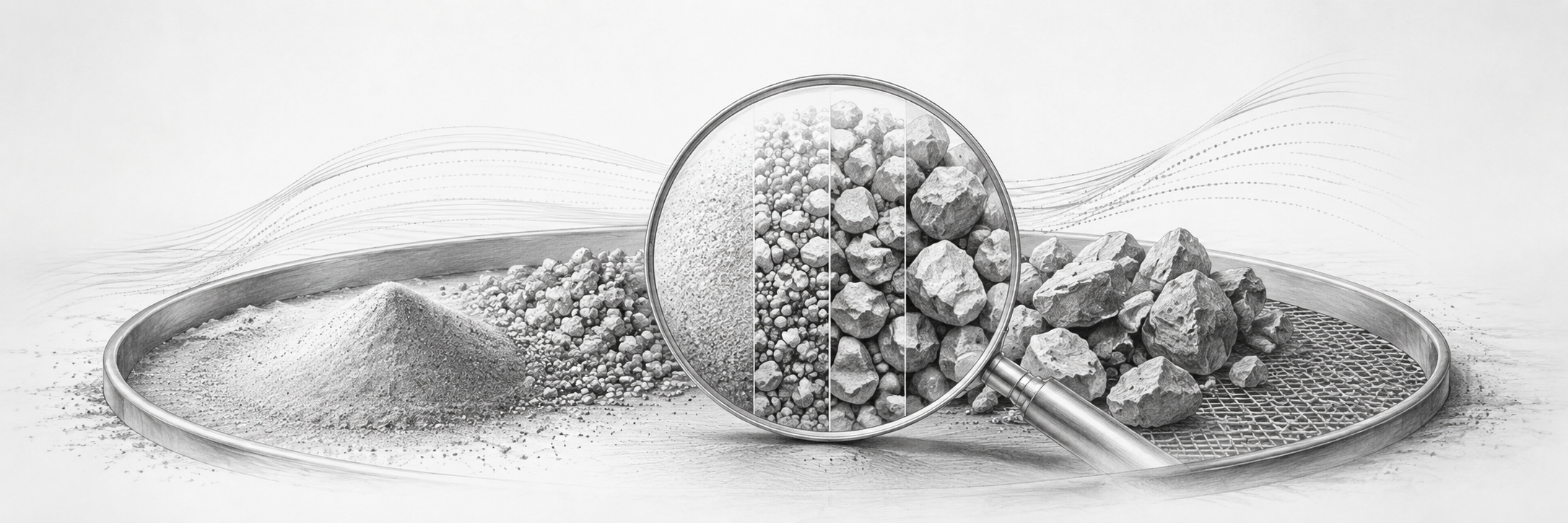
Mesh, fines, coarse particles, and milling consistency affect flow, mouthfeel, hydration speed, and visual quality.
Matrix fit
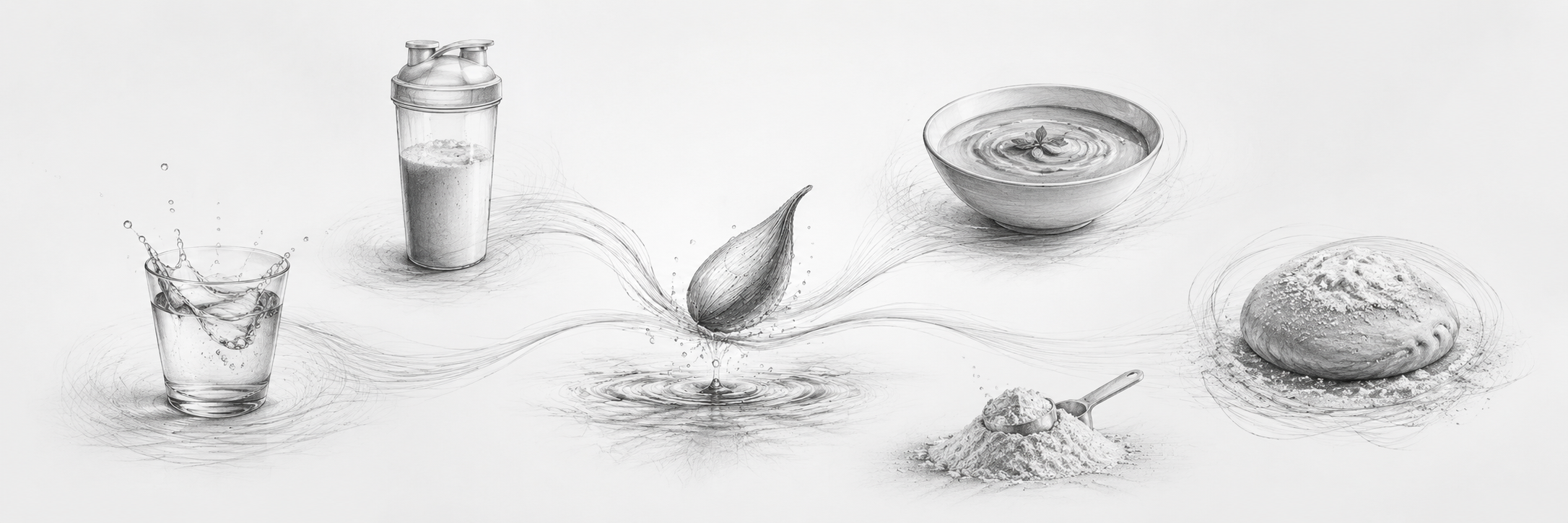
Fibre behaves differently in water, milk, protein shakes, bakery systems, soups, premixes, and high-mineral or low-sugar formats.
Technical answers
Technical questions
Why does hydration matter in fibre?
Hydration controls how quickly fibre takes up water. It affects powder wetting, clump formation, preparation time, viscosity development, texture, and whether the experience is repeatable in daily use or food processing.
Why is viscosity important in fibre systems?
Some plant fibres can build strong viscosity when they swell in water. The rate and level of viscosity affect drink thickness, mouthfeel, serving window, product handling, and suitability for the intended format.
What is swelling behavior?
Swelling behavior describes how a fibre expands and holds water. It is especially important for gums, mucilages, resistant starches, and plant fibres used for body, texture, or water management.
Why does matrix fit matter?
A fibre behaves differently in plain water, protein shakes, milk, bakery dough, soups, sweetened powders, mineral systems, and heated foods. Matrix fit connects the fibre behavior to the actual product environment.
India gives Fybrance a strong starting point for plant fibres.
India has a long history of growing and processing plant ingredients, from grains and pulses to gums, mucilages, resistant starch sources, and botanical materials used in food and nutrition.
Fybrance works from within that sourcing base but goes further: understanding the raw material, testing it in real applications, and checking how the finished product performs. The goal is to be a fibre partner whose claims can be checked and trusted.
The working rule
Evidence and claims policy
A fibre earns trust when we know exactly what it is, we have measured how it behaves, and the documents confirm both. If any of those is missing, the claim waits.
Fibre science
Fibre Performance and Application Properties
Fibre performance depends on ingredient identity, grade, particle profile, processing history and the formulation in which it is used.
Fibre behaviour is determined by the material, formulation matrix and process.
Particle size, surface condition, soluble and insoluble fractions, processing history and storage can alter the first seconds of wetting and the final product texture.
The surrounding matrix matters just as much. Water, protein, sugar, minerals, fat, pH, temperature and shear can change the same fibre's apparent performance.
Performance map
Key Fibre Performance Properties
Hydration
How quickly and completely a material takes up water.
Wetting
Whether liquid reaches the particle surface before dry pockets form.
Dispersion
How evenly particles distribute through the matrix during mixing.
Swelling
How a material expands as water enters its structure.
Viscosity
How thickness develops over time, temperature and shear.
Gel formation
Whether and how a connected structure forms in the system.
Fermentation
How fermentable fractions may interact with the gut microbiota, subject to composition and evidence.
Particle size
How particle distribution affects flow, dusting, hydration and mouthfeel.
Bulk density
How powder volume and packing affect handling, blending and dosing.
Water binding
How water is retained during mixing, heating, cooling and storage.
Oil binding
How fibre may interact with fat phases in a specific formulation.
Sensory effect
How colour, flavour, grittiness, body and after-feel influence acceptance.
Processing matrix
How pH, salts, protein, sugar, fat, heat and shear alter behaviour.
Storage effects
How moisture, time and packaging conditions influence stability and performance.
Same name, different profile
Functional Performance Varies by Grade and Process
Materials with the same generic ingredient name can differ in particle profile, hydration, viscosity, colour, flavour, microbial profile and processing behaviour.
That is why a technically useful comparison controls the test method, liquid ratio, mixing energy, temperature and observation window.
From property to product
Application Requirements Define Relevant Performance
A drink powder may need enough time to disperse before viscosity rises. A gluten-free dough may need water management and network support. A nutrition powder may intentionally use body and controlled thickness. There is no single “best” fibre outside an application.
Explore application pathwaysA practical evaluation sequence
Fibre Evaluation Process
- 01
Define the product
Format, process, target market, serving context and label constraints.
- 02
Define Performance Requirements
Clumping, weak structure, excessive thickness, sedimentation, dryness, grittiness or inconsistency.
- 03
Select the relevant measures
Use repeatable tests that reflect the matrix and the customer's real preparation or process.
- 04
Compare qualified candidates
Review evidence and performance without assuming that catalogue names are interchangeable.
- 05
Validate in the application
Confirm behaviour through bench, pilot and finished-product testing.
Technical answers
Technical FAQs
Why can two samples with the same fibre name behave differently?
Botanical source, plant part, processing route, particle profile, moisture, storage and the product matrix can all change hydration, texture and processing behaviour.
Which fibre property should a formulator evaluate first?
Start with the application problem. A beverage may prioritise wetting and dispersion, while bakery may prioritise water binding, dough handling and structure.
Does a specification predict finished-product performance?
A specification supports material control, but it cannot model every formula and process. Bench and pilot trials remain necessary for application fit.
Can Fybrance help compare fibre grades?
Yes. Share the target application, process and performance requirements so the comparison can focus on the properties that matter in that system.