
Formulation option
Water-Agglomerated Psyllium Powder
Water-agglomerated psyllium powder explores water-mediated particle binding for larger granules. The development focus is particle formation, drying and preparation behaviour with a tightly controlled composition.
Composition and specifications agreed for your application.
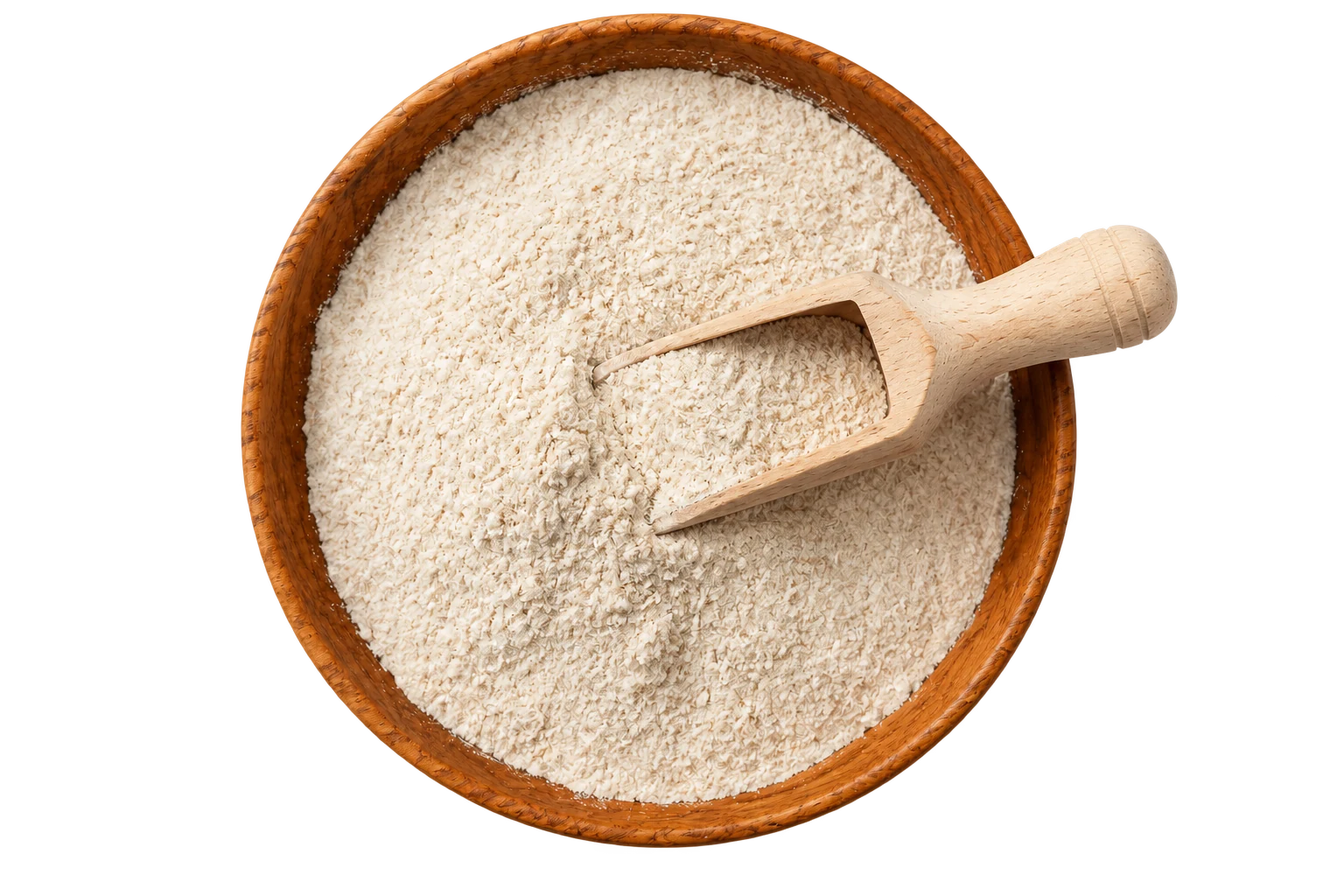
Water-mediated agglomeration
Controlled wetting, particle contact and drying
Agglomeration with water as the processing medium
Water-agglomerated psyllium powder is a development route in which controlled wetting promotes contact and binding between psyllium particles. The objective is a defined granule structure rather than unrestricted hydration. Psyllium's strong interaction with water makes the balance between wetting and drying central to feasibility.
This option is relevant when a brief seeks to minimise supporting ingredients. It is not a blanket promise of a binder-free or single-ingredient commercial material: composition and processing suitability must be demonstrated for the proposed grade.
Particle formation and drying
Fluidised particle wetting and drying is a route to assess during development. Water delivery, contact conditions and drying determine whether a useful granule forms or the powder becomes an over-wetted mass. Trials should establish granule distribution, residual moisture and the amount of loose fines after drying and screening.
Granule strength also matters after manufacture. A sample that appears suitable before transport may break down during blending or filling. Evaluate the powder after realistic handling, and compare it with an acacia-bound or maltodextrin-bound agglomerated psyllium when additional binding support is acceptable.
Where this route fits
Consider it for ingredient-led fibre powders and dry premixes with a restrictive supporting-ingredient brief. The application must tolerate psyllium's gel-forming behaviour. A larger particle size does not on its own prove improved dispersion, reduced dust or a longer drinking window.
Preparation and feasibility checks
Test whether granules wet throughout, separate under the intended mixing method and produce the required hydrated texture. Examine hard centres, floating granules and changes in viscosity. If sufficient granule integrity and preparation behaviour cannot be achieved together, revisit the binder strategy instead of treating water processing as an automatic substitute.
How to evaluate the formulation
Compare the proposed option with the current psyllium at the same psyllium content, not simply the same total powder weight. Supporting ingredients change the amount of psyllium in each gram. Record the liquid, temperature, addition order, mixing method and holding time before comparing samples.
| Evaluation | What to record |
|---|---|
| Wetting and dispersion | Surface floating, dry-cored lumps and distribution after a fixed mixing period. |
| Hydration and viscosity | Development over agreed time points using the same instrument, geometry and temperature. |
| Particle handling | Size distribution, fines, bulk density, flow and changes after transport or blending. |
| Finished-product fit | Appearance, flavour, mouthfeel and behaviour in the complete recipe. |
| Composition and quality | Psyllium content, supporting ingredients, moisture, microbial specification and relevant contaminant results. |
Specifications, documents and sample evaluation
Share your target market, acceptable ingredients, intended process and expected scale. Request the proposed composition and ingredient declaration, a technical data sheet, batch certificate of analysis, allergen information and storage guidance. Origin, residue testing, certification scope and other declarations should be checked for the actual material.
Public information describes a formulation option. Final composition, process, specifications, sample arrangements, packaging, availability and commercial terms are agreed during enquiry. Only relevant, verified documents will be supplied; this page does not offer a downloadable specification or promise certification.
Technical background
Historical publications describe acacia-based psyllium coating and agglomeration and maltodextrin-based psyllium agglomeration. These provide processing background, not proof of a Fybrance SKU or a guarantee for the proposed formulation.
Technical questions
Before you select a format.
Does water-agglomerated mean no added binder?
It describes the proposed water-mediated development route. A no-added-binder declaration is made only when the actual composition and manufacturing route support it.
Will larger granules always disperse faster?
No. Porosity, strength and surface behaviour matter alongside size. The intended liquid and preparation method must be used to compare samples.
Compare within this category
Other formulation options
Start with your product
What happens when you add psyllium?
Tell us what you are making, how it is prepared and what needs to improve. We will discuss the formulation direction, specification requirements and evaluation scope.