
Most people meet fibre too late.

Usually, it enters the conversation after something has already gone wrong. The stomach feels heavy. The bowel feels slow. A doctor says, "Increase fibre." A parent says, "Take isabgol." A pharmacy shelf says, "Digestive relief."

Over time, an entire nutrient gets reduced to one job: constipation.

That is unfair to fibre.

Constipation relief is one visible effect of fibre, but it is not the whole story. Inside the body, fibre behaves less like a quick remedy and more like a daily operating system. It changes the physical behaviour of food. It affects how water moves through the gut. It influences stool form, microbial activity, satiety, bile acid movement, glucose absorption, and the texture of foods themselves.

Fibre is not just about going to the toilet.

Fibre is about what happens to food after we stop chewing.

The body cannot digest fibre. That is exactly why it matters.

Most nutrients are valued because the body can break them down.

Carbohydrates become glucose. Proteins become amino acids. Fats become fatty acids. These are absorbed, transported, stored, burned, rebuilt, and reused.

Fibre is different.

Dietary fibre refers to plant-based carbohydrate structures that resist digestion by human enzymes. That means our body cannot fully break them into simple absorbable units in the small intestine.

At first, that sounds like a weakness.

But biologically, that resistance is the feature.

Because fibre does not disappear early in digestion, it continues travelling through the gastrointestinal tract while still carrying physical function. Depending on the type of fibre, it may hold water, form a gel, increase viscosity, feed gut bacteria, add bulk, slow nutrient movement, bind certain compounds, or improve food structure.

In simple words, fibre is not important because it becomes energy.

It is important because it changes the journey of food.

Fibre is not one ingredient

One of the biggest mistakes in nutrition is speaking about fibre as if it is a single substance.

It is not.

Fibre is a large family of plant-based structures with different behaviours. Some fibres dissolve in water. Some do not. Some ferment rapidly in the colon. Some ferment slowly. Some form gels. Some remain coarse. Some are useful for stool bulk. Some are better known for feeding beneficial bacteria. Some are valuable in food formulation because they bind water or improve texture.

This is why two high-fibre foods can feel completely different in the body.

Wheat bran, oats, apple pectin, resistant starch, inulin, acacia gum, partially hydrolysed guar gum, beta-glucan, psyllium husk, vegetable fibres, and seed fibres are all fibre, but they do not behave in the same way.

Calling all of them simply fibre is like calling every vehicle transport. A bicycle, bus, truck, train, and aircraft all move things, but the mechanism and purpose are different.

The same is true inside the gut.

The real question is not only, "How much fibre?"

The better question is, "What kind of fibre, in what amount, with how much water, in what food system, and for what purpose?"

The physics of fibre starts with water

A lot of fibre science begins with a very ordinary molecule: water.

Some fibres have a remarkable ability to hold water. When hydrated, they swell, thicken, or form gel-like networks. Psyllium is one of the clearest examples. When it comes into contact with water, it forms a viscous gel.

This gel formation explains why psyllium is so misunderstood.

From the outside, people see thickening and think, "This is a laxative."

But inside the digestive tract, that same gel can do several things.

It can increase water in hard stools. It can improve stool consistency in loose stools. It can slow the movement and mixing of nutrients. It can increase the viscosity of chyme, the semi-digested mixture moving through the small intestine. It can influence fullness by changing how substantial the digestive contents feel. It can also physically interact with bile acids, which are involved in fat digestion and cholesterol metabolism.

So the gel is not just a texture.

The gel is the mechanism.

This is why the same fibre can be relevant to regularity, fullness, metabolic response, and food formulation. Its effect is not magic. It is material science happening inside biology.

Fibre does not scrub the gut

A common old explanation says fibre works like a broom that sweeps the intestine.

That image is simple, but it is not very accurate.

The gut is not a dirty pipe. It is a living, moving, sensing organ lined with cells, mucus, nerves, immune activity, microbes, and chemical signals. Food does not simply fall through it. It is mixed, squeezed, hydrated, fermented, absorbed, delayed, accelerated, softened, and transformed.

Fibre works less like a broom and more like an intelligent material.

Insoluble fibres can add bulk and structure. Viscous fibres can thicken the contents of the small intestine. Fermentable fibres can become food for gut microbes. Gel-forming fibres can hold water and change stool form.

This is a more useful way to think about fibre: not as rough material scraping the gut, but as plant structure that changes the physical and biological environment of digestion.

That is far more interesting than constipation.

Regularity is not the same as laxation

The word laxative suggests forcing something to happen.

But many fibres do not work by forcing. They work by normalising.

That distinction matters.

A stimulant laxative pushes bowel movement by irritating or stimulating intestinal contractions. Some osmotic laxatives pull water into the bowel. These can be useful in specific situations, but they are not the same as building a fibre-rich daily diet.

Certain fibres, especially gel-forming fibres, can support stool form in a more balanced way. In hard stools, water-holding fibre can help soften. In loose stools, gel structure can help improve consistency. This is why the phrase stool normalising is more accurate than simply laxative for some fibres.

The goal is not always more motion.

The goal is better form, better hydration, better rhythm, and fewer extremes.

A healthy bowel is not judged only by frequency. It is also judged by ease, consistency, comfort, and predictability.

Beyond regularity: the larger fibre story

Constipation is only one part of the fibre conversation. In future blogs, we will go deeper into four other areas where fibre becomes scientifically interesting.

We will look at how fibre affects fullness, and why texture and viscosity can change appetite. We will explain how fibre can slow the speed of glucose absorption after meals. We will unpack the quiet relationship between fibre, bile acids, and cholesterol. We will also explore how different fibres interact with the gut microbiome, not as a trend, but as food for the organisms already living with us.

Each of these topics deserves its own space. For now, the important idea is simple: fibre is not a single-purpose digestive aid. It is a daily part of how food moves, feels, slows, feeds, and communicates inside the body.

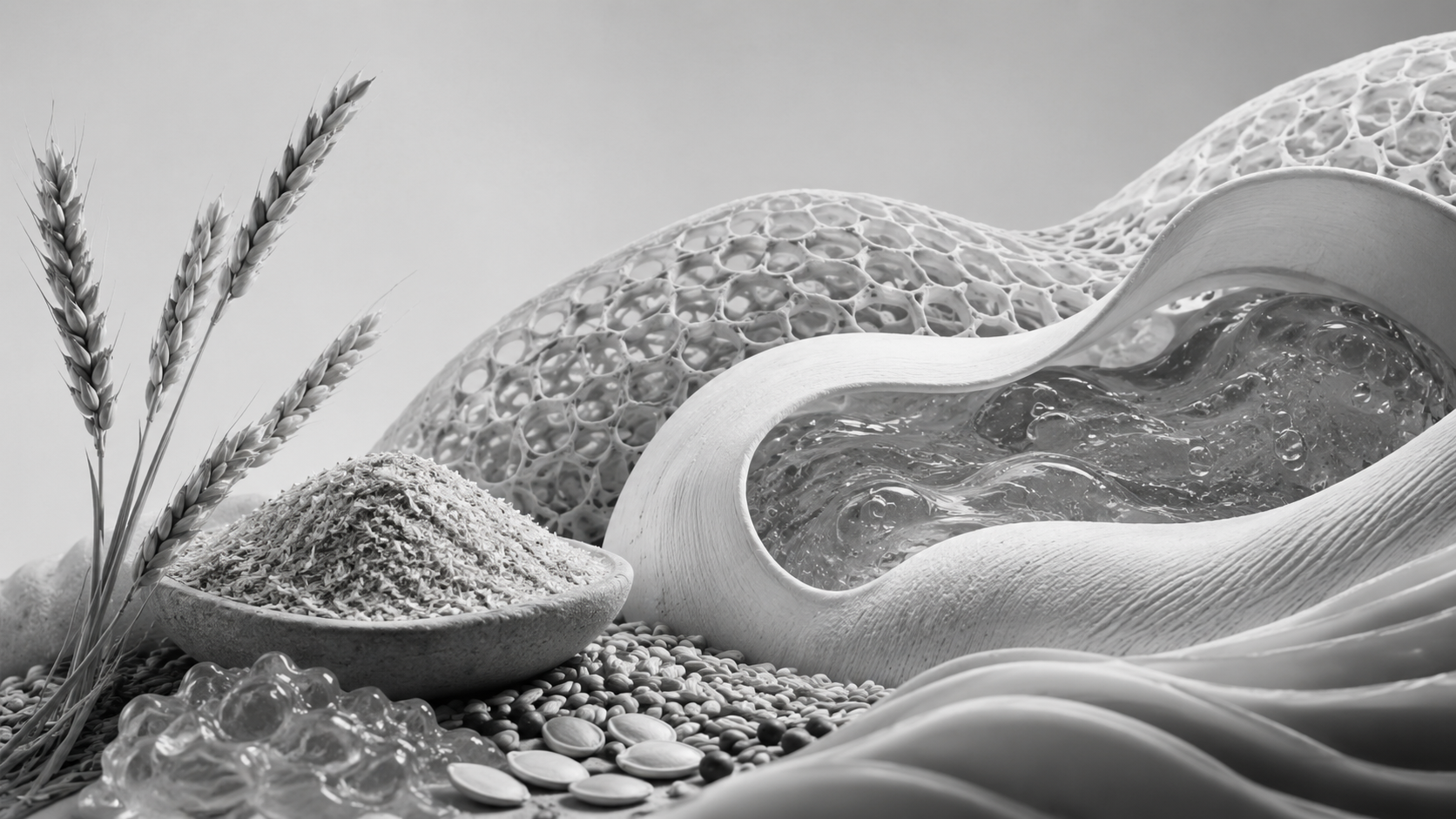
Monochrome illustration of digestion with fibre topics: hydration, microbiome, glucose response, cholesterol balance, and stool quality.

Modern diets made fibre invisible

For most of human food history, fibre was naturally present because food was less refined.

Pulses had skins. Grains had bran. Fruits were eaten whole. Vegetables were routine. Seeds, nuts, roots, and plant structures were part of daily meals.

Modern food processing made eating easier, softer, faster, sweeter, and more shelf-stable. But it also removed a lot of plant structure.

Fruit became juice. Wheat became refined flour. Snacks became starch-fat-salt systems. Breakfast became cereal dust. Meals became soft, low-residue, low-chew, low-fibre formats.

This changed the digestive workload.

The gut evolved to handle texture, bulk, fermentation, and plant complexity. A modern low-fibre diet gives it calories without enough structure.

That is the hidden problem.

We did not only remove nutrients. We removed resistance.

We removed the part of food that asks the digestive system to slow down, hydrate, ferment, form, and regulate.

Fibre is a daily design problem

The most useful way to think about fibre is not as emergency relief.

It is daily design.

A good fibre pattern in the diet should help design better meals: more whole plant foods, more legumes, more vegetables, more seeds, more intact grains, more diversity, more texture, more water, and more regularity.

This does not mean every person needs the same fibre or the same amount immediately. Sudden large increases can cause gas, bloating, discomfort, or poor compliance, especially if water intake is low or the gut is not used to it.

Fibre is best built gradually.

The gut adapts. Microbes adapt. Habits adapt. Water intake matters. Food context matters. Individual tolerance matters.

A technically correct fibre habit is not just "take more fibre."

It is "build the right fibre pattern slowly enough that the body accepts it."

The better question

The old question was, "Are you constipated?"

The better question is, "Is your daily food giving your gut enough structure to work with?"

That question changes everything.

It moves fibre away from embarrassment and into normal nutrition. It moves the conversation from relief to routine. It makes fibre relevant not only to bowel movement, but to fullness, food quality, metabolic rhythm, microbiome nourishment, and the physical design of meals.

Constipation may be the moment many people discover fibre.

But it should not be the only reason they respect it.

Fibre is not a backup plan for bad digestion.

Fibre is one of the basic materials of good digestion.

Perhaps the most important shift is this: we should stop seeing fibre as something we take when the body fails.

We should start seeing it as something the body expected all along.

Disclaimer

This article is for general nutrition education only. It is not medical advice. People with digestive disorders, swallowing difficulty, diabetes, kidney disease, bowel obstruction risk, medication schedules, pregnancy-related concerns, or chronic symptoms should speak with a qualified healthcare professional before making major dietary or supplement changes.