
Cholesterol is usually discussed loudly.

Good cholesterol. Bad cholesterol. Heart risk. Oil. Ghee. Eggs. Fried food. Blood reports. Tablets. Fear.

The conversation becomes stressful very quickly.

But inside the body, cholesterol is not simply a "bad thing." It is a necessary molecule. The body uses cholesterol to build cell membranes, make hormones, produce vitamin D, and create bile acids that help digest fats.

The problem is not cholesterol itself.

The problem is when cholesterol transport and balance move in the wrong direction over time.

This is where fibre becomes interesting again.

Not as a dramatic cure. Not as a replacement for medical care. Not as something that can cancel a poor diet.

Fibre matters because certain fibres can quietly change one specific route in the body: the bile acid route.

It is not a loud mechanism.

It is not instant.

It is not glamorous.

But it is one of the most elegant ways fibre connects the gut to cholesterol metabolism.

Cholesterol is not only about the fat you eat

Most people think cholesterol comes only from food.

That is not true.

The body makes cholesterol. The liver plays a central role in making, packaging, recycling, and regulating it. Food matters, but the body's internal cholesterol system matters too.

This is why two people can eat similar diets and still have different cholesterol numbers. Genetics, body weight, insulin resistance, thyroid function, liver metabolism, activity level, smoking, alcohol, medication, age, and overall diet pattern can all influence the final picture.

Cholesterol is not floating freely in the blood like oil in water.

It travels inside particles called lipoproteins. LDL and HDL are two well-known examples. LDL particles carry cholesterol from the liver toward tissues. HDL particles help move cholesterol back toward the liver. This is why LDL is often called "bad cholesterol" and HDL is often called "good cholesterol," though the real biology is more complex.

The important point is simple: cholesterol management is not only about removing one food.

It is about how the whole system moves.

The liver is the control room

The liver is one of the body's great managers.

It processes nutrients, stores energy, makes proteins, handles toxins, produces cholesterol, clears cholesterol, and makes bile.

Bile is a digestive fluid. It helps the body deal with fats. Fat does not mix easily with water, and digestion happens in a watery environment. Bile helps emulsify fat, meaning it breaks fat into smaller droplets so digestive enzymes can work more effectively.

Bile contains bile acids.

And bile acids are made from cholesterol.

This is where the story begins.

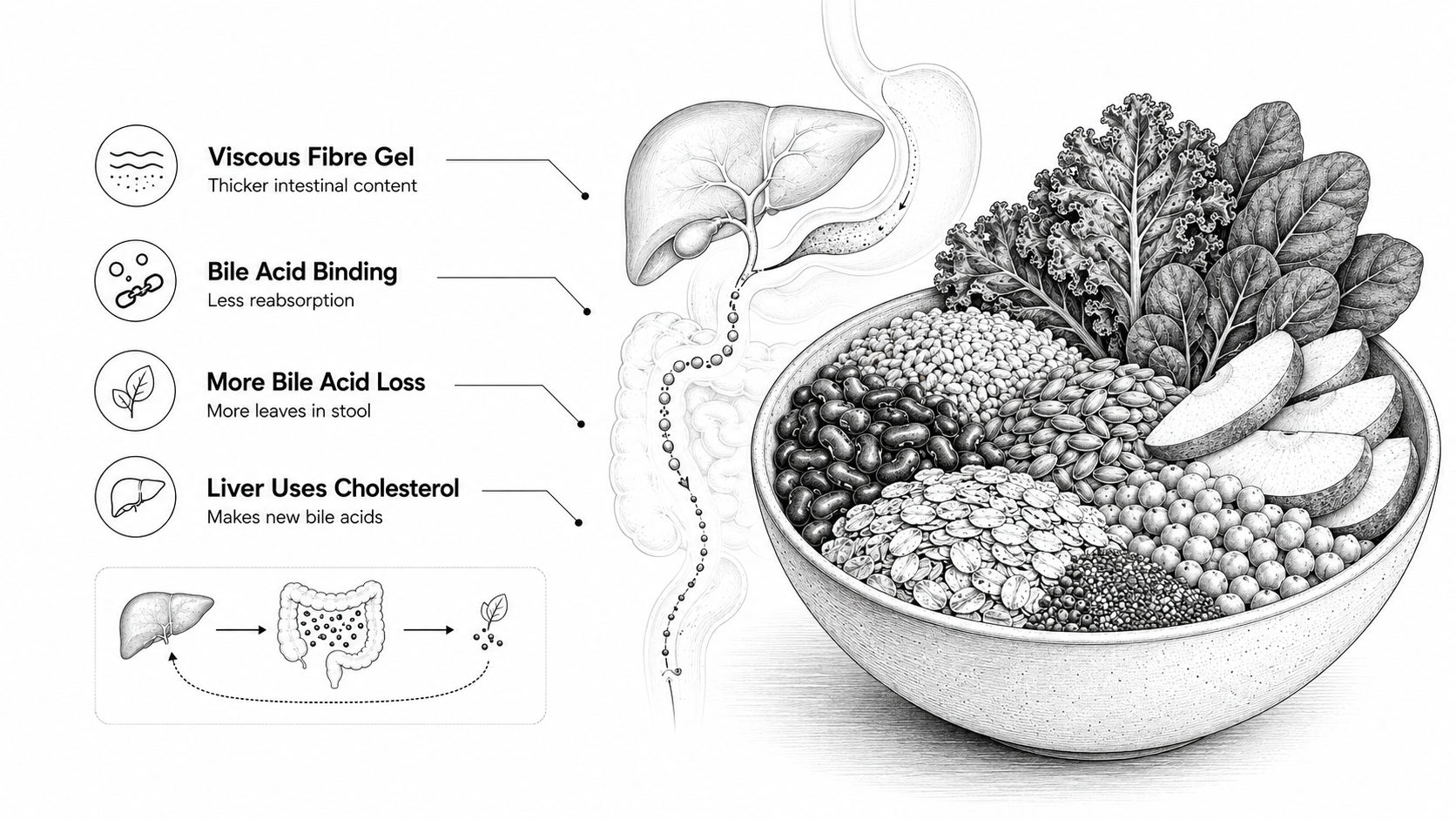
The body uses cholesterol to make bile acids. These bile acids are released into the small intestine when food, especially fat-containing food, needs digestion. After they do their job, the body does not usually waste them. It recycles them.

This recycling system is called enterohepatic circulation.

That sounds technical, but the idea is simple.

Bile acids go from liver to gut, help digest fat, then return from gut to liver for reuse.

The body is efficient.

It likes to recycle.

Bile acids are meant to return

Most bile acids are reabsorbed near the end of the small intestine and sent back to the liver.

This makes sense. Bile acids are useful. The body has already spent energy making them. So instead of losing them every time we eat, the body recovers most of them.

Think of it like a reusable cleaning fluid.

The liver sends it out, the intestine uses it, then the body collects most of it back.

But not all of it returns. Some bile acids leave through stool. When this happens, the liver needs to replace them by making new bile acids.

To make new bile acids, the liver uses cholesterol.

This is the quiet connection.

If more bile acids are lost, the liver has to make more. If the liver has to make more, it may draw more cholesterol into that process.

This is where certain fibres enter the story.

Fibre can interrupt the recycling loop

Not all fibres strongly affect bile acids.

The effect is mostly linked with viscous, gel-forming fibres.

When these fibres hydrate, they form a thick gel-like network. This gel can increase the viscosity of the contents moving through the small intestine. It can also physically trap or bind bile acids.

If bile acids are trapped inside a viscous fibre gel, they may not be reabsorbed as efficiently.

Instead, more of them may continue through the intestine and leave the body in stool.

That means the liver receives fewer recycled bile acids.

So the liver makes more.

And because bile acids are made from cholesterol, this can influence cholesterol metabolism over time.

This is one of the major reasons certain soluble, viscous fibres are linked with improved cholesterol numbers.

It is not magic.

It is a physical mechanism repeated daily.

The gel is the mechanism

This is why the type of fibre matters.

A fibre that simply adds roughage may help stool bulk, but it may not form the same viscous gel in the small intestine.

A fibre that dissolves but does not become viscous may not have the same bile acid effect.

A highly fermentable fibre may feed gut bacteria, but may not travel through the small intestine as a strong gel.

Gel-forming fibres are different.

They create a physical material inside digestion.

Psyllium is one example. When hydrated, it forms a viscous gel. Beta-glucan from oats and barley is another well-known viscous fibre. Some pectins and gums may also influence viscosity, depending on structure and food context.

The key idea is not just "soluble fibre."

The key idea is viscosity.

For cholesterol, the fibre must do more than appear on a nutrition label. It must create the right physical behaviour in the gut.

LDL cholesterol enters the story

When more bile acids are lost through stool, the liver needs cholesterol to make new bile acids.

One way the liver can obtain cholesterol is by pulling LDL particles from the blood through LDL receptors.

This is why the bile acid route can influence LDL cholesterol.

The liver is not thinking in words. It is responding to supply and demand.

If bile acid recycling falls, bile acid production needs to rise. If bile acid production rises, cholesterol demand inside the liver changes. If the liver needs more cholesterol, it may increase uptake from circulating LDL particles.

Over time, this can support healthier LDL cholesterol patterns in some contexts.

The effect is usually gradual. It depends on fibre type, dose, diet pattern, consistency, baseline cholesterol level, genetics, medications, and overall metabolic health.

It is not a switch.

It is a nudge.

But daily nudges matter in biology.

This is not the same as blocking fat

Fibre does not simply "block fat" in a crude way.

That is too simplistic.

Fat digestion is a normal and necessary process. The body needs dietary fat for energy, cell structure, hormones, and absorption of fat-soluble vitamins. The goal is not to stop fat digestion.

The bile acid mechanism is more subtle.

Viscous fibre changes the digestive environment. It can reduce the efficient recycling of bile acids. It may also slow interactions between digestive enzymes, bile acids, and nutrients. The result is not that food becomes useless. The result is that the system behaves differently.

This is important because many people want simple explanations.

"Fibre removes fat."

"Fibre melts cholesterol."

"Fibre cleans arteries."

These are not good explanations.

A better explanation is this:

Certain fibres can increase bile acid loss through stool. The liver may then use cholesterol to make replacement bile acids. Over time, this can support healthier cholesterol balance.

That is technical, but it is honest.

Why oats became famous

Oats became famous partly because of beta-glucan.

Beta-glucan is a soluble, viscous fibre found in oats and barley. It can increase viscosity in the gut and is linked with cholesterol-supportive effects when consumed consistently in adequate amounts.

This is why oats are often discussed in heart-health conversations.

But the lesson is not "eat oats and ignore everything else."

The lesson is that food structure matters.

A bowl of plain oats is different from a sugary oat biscuit. Barley in a meal is different from a sweetened cereal. A fibre-rich food eaten daily is different from a health claim printed on a packet.

The fibre has to be present in a meaningful amount.

The food has to be eaten consistently.

The overall diet still matters.

Why psyllium is different from many fibres

Psyllium is interesting because it is strongly gel-forming and has high water-holding capacity.

When hydrated properly, it forms a viscous gel that can travel through the digestive tract. This gel behaviour is central to its effects on stool form, satiety, glucose absorption, and bile acid movement.

For cholesterol, the gel matters because it can interfere with bile acid reabsorption.

This is why psyllium is not just "isabgol for constipation."

That old view is too narrow.

The same physical property that helps stool normalisation also helps explain its role in metabolic health.

Water-holding, gel formation, and viscosity are not separate stories. They are the common mechanism behind multiple effects.

Again, this does not mean everyone should start taking large doses without guidance.

It means the ingredient deserves to be understood more accurately.

The gut and the liver are always talking

It is easy to think of organs separately.

The gut digests food.

The liver handles cholesterol.

The heart is affected later.

But biology is not so separate.

The gut and liver are closely connected through blood flow, bile movement, nutrient absorption, microbial products, and metabolic signalling. What happens in the intestine can affect what the liver has to do next.

Bile acid recycling is one of the clearest examples.

A molecule made by the liver enters the gut. A fibre in the gut changes whether that molecule returns. The liver then adjusts its own metabolism.

That is a gut-liver conversation.

Fibre is part of the message.

Cholesterol response depends on the whole diet

It is tempting to isolate one mechanism and expect too much from it.

That is not wise.

Fibre can help, but cholesterol response depends on the entire diet pattern.

A diet high in refined carbohydrates, excess calories, deep-fried foods, low activity, poor sleep, and low plant food intake will not be transformed by one spoon of fibre.

The bigger pattern still matters.

For cholesterol, the diet usually improves when it includes more legumes, vegetables, fruits, nuts, seeds, whole grains, and appropriate fats. It improves when ultra-processed foods reduce. It improves when the plate has more structure and less constant snacking. It improves when fibre is not an emergency addition, but a normal part of food.

Fibre works best when it belongs to the meal, not when it is used to compensate for the meal.

The stool is part of cholesterol metabolism

This sounds strange, but it is true.

Some cholesterol-related material leaves the body through stool.

Bile acids are part of that route.

This gives the gut an important role in cholesterol balance. The gut is not just a place where food waste is made. It is also a route through which the body can remove certain compounds.

When fibre increases stool bulk, water-holding, and gel structure, it can change what gets carried out.

That does not make the stool glamorous.

But it makes it biologically important.

A healthy digestive system is not only about comfort. It is part of metabolic housekeeping.

Why consistency matters more than intensity

The bile acid mechanism is not a one-day story.

You cannot eat fibre once and expect a major cholesterol change.

This is a repeated process. Meal after meal, day after day, the gut receives fibre. The fibre hydrates. The gel forms. Bile acid recycling is affected. The liver responds. Blood lipid patterns may shift gradually.

That is why consistency matters.

Small daily habits often outperform aggressive short bursts.

A month of better meals is more meaningful than one perfect breakfast. A year of adequate fibre is more meaningful than one week of panic after a blood test.

The body changes through repetition.

Fibre belongs to repetition.

The meal matrix matters

A fibre ingredient does not act in empty space.

It acts inside a meal.

The same fibre may behave differently depending on water, timing, food texture, fat content, protein, cooking method, and how quickly the meal is eaten.

This is why whole food patterns are powerful. They provide fibre inside a complete structure. Legumes bring fibre with protein and starch. Oats bring beta-glucan with starch and water absorption. Fruits bring pectin with water and plant cells. Vegetables bring bulk, texture, and micronutrients. Nuts and seeds bring fibre with fats and minerals.

A good meal is not just a collection of nutrients.

It is a working system.

Fibre claims can be misleading

Many packaged foods use fibre as a badge.

High fibre. Added fibre. Good for heart. Better digestion.

Sometimes that is useful. Sometimes it is marketing.

A food can contain added fibre and still be highly processed, high in sugar, low in protein, easy to overeat, and poor in overall quality.

For cholesterol, the type of fibre matters. The amount matters. The food matrix matters. The rest of the diet matters.

A small amount of random fibre added to a sugary snack should not be treated the same as a meal built around legumes, oats, vegetables, seeds, and viscous fibres.

The label may say fibre.

The body asks, "What kind, how much, and in what form?"

Dietary fat still matters

Fibre is not an excuse to ignore fat quality.

Some fats are better suited to daily eating patterns than others. Diets that rely heavily on fried foods, trans fats, repeated reheated oils, and excessive saturated fat can still worsen lipid patterns in many people.

At the same time, fat should not be treated with blind fear.

Nuts, seeds, fish, olive oil, mustard oil, groundnut oil, and other traditional fats can all fit differently depending on the person and diet pattern. The issue is not fat alone. It is dose, quality, cooking method, and total meal pattern.

Fibre adds another layer.

A fibre-rich meal with better fats behaves differently from a low-fibre, deep-fried, refined meal.

The body reads the whole plate.

The Indian plate has both risk and opportunity

Indian food can be very high in fibre, or very low in fibre.

It depends on how it is built.

A plate with dal, chana, rajma, sabzi, salad, millet, curd, fruit, nuts, and seeds can be rich in fibre and structure.

A plate built mostly on refined flour, white rice, fried snacks, sweets, sweet tea, biscuits, and low vegetables can be fibre-poor and cholesterol-unfriendly.

The same cuisine contains both paths.

This is good news.

Improvement does not always require foreign food or extreme dieting. It may simply mean bringing back the parts of the plate that used to do metabolic work: pulses, vegetables, intact grains, seeds, fermented foods, and fruit in whole form.

The solution may be less about novelty and more about restoring structure.

Medication and fibre need timing

For people taking cholesterol medicines, diabetes medicines, thyroid medicines, blood thinners, or other long-term medication, fibre timing matters.

Some fibres can affect how medicines are absorbed if taken too close to them. This does not mean fibre is unsafe for everyone. It means timing and medical guidance matter.

People with high cholesterol should not stop prescribed medication because they increased fibre.

That is not responsible.

Fibre can be part of the pattern. It can support better diet quality. It can help shift the metabolic environment. But medical treatment decisions belong with a qualified healthcare professional.

Food can be powerful without pretending to be medicine.

What a cholesterol-aware fibre pattern looks like

A cholesterol-aware fibre pattern is not complicated.

It usually looks like this:

More legumes.

More vegetables.

More oats or barley where they fit.

More whole fruits instead of juices.

More nuts and seeds in sensible portions.

More intact grains when possible.

Less ultra-processed food.

Less refined flour dependence.

Enough water.

Consistent meals.

This pattern brings multiple benefits at once. Fibre improves structure. Plant foods bring micronutrients and phytochemicals. Protein from pulses improves fullness. Better fats support the meal. Chewing slows eating. The gut receives more material to work with.

This is how cholesterol nutrition becomes practical.

Not one miracle food.

A better daily system.

Why the mechanism feels quiet

Some health effects are loud.

Caffeine feels loud. Sugar feels loud. Spicy food feels loud. Alcohol feels loud.

Fibre is quiet.

You may not "feel" bile acids being trapped. You may not notice the liver increasing bile acid production. You may not sense LDL receptor activity changing.

The mechanism happens below awareness.

This is why fibre is easy to underestimate.

It does not announce itself.

But biology does not require drama to be meaningful.

Sometimes the most useful changes are the quiet ones.

The better question

The old question was, "Does this food have cholesterol?"

The better question is, "Does my daily diet help my body handle cholesterol well?"

That question changes the focus.

It moves attention from one ingredient to the whole system. It makes fibre visible. It makes bile acids relevant. It makes the gut part of cholesterol metabolism. It makes daily repetition more important than panic.

Cholesterol is not only a fat story.

It is also a fibre story.

A liver story.

A bile acid story.

A gut story.

Final thought

Fibre does not attack cholesterol.

It does something more elegant.

Certain fibres change the physical environment of digestion. They form viscous gels. They affect bile acid recycling. They increase the chance that bile acids leave through stool. The liver then has to make more bile acids, using cholesterol as part of that process.

It is quiet.

It is slow.

It is not a replacement for medical care.

But it is real enough to respect.

The body is full of loops. Fibre works because it enters one of those loops and changes the direction slightly, meal after meal.

That is why fibre should not be seen only as a digestive aid.

Sometimes, the route to cholesterol begins in the gut.

Disclaimer

This article is for general nutrition education only. It is not medical advice. People with high cholesterol, heart disease, diabetes, thyroid disorders, liver or gallbladder conditions, kidney disease, digestive disorders, swallowing difficulty, medication schedules, pregnancy-related concerns, or chronic symptoms should speak with a qualified healthcare professional before making major dietary or supplement changes.