
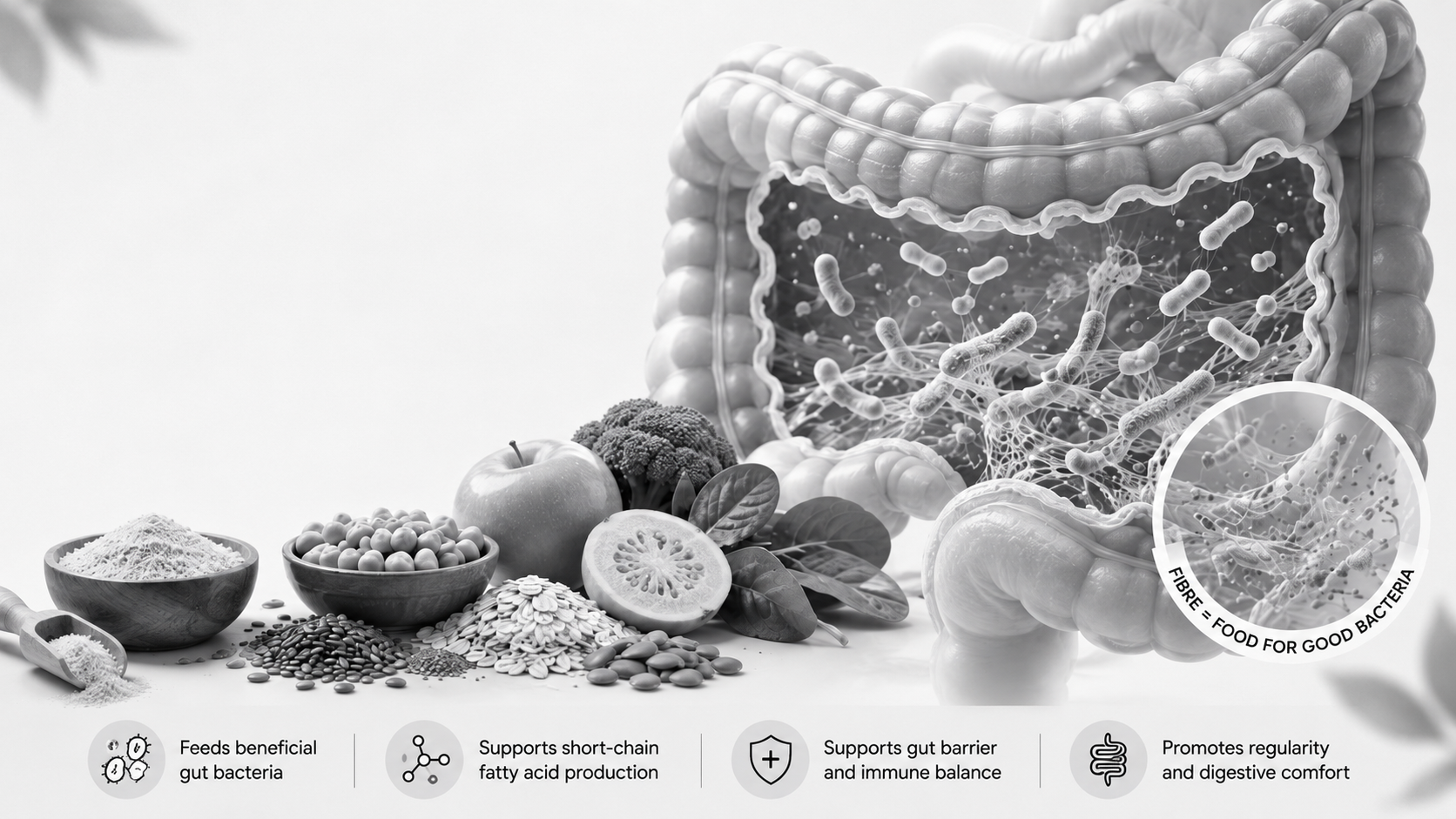
We do not eat alone.
Every meal we eat also feeds a hidden world living inside us.
The gut contains trillions of microorganisms: bacteria, fungi, viruses, and other tiny life forms. Together, they form what we call the gut microbiome. It sounds modern because the word is everywhere now, but the relationship is ancient. Humans have always lived with microbes. We just became better at noticing them.
For a long time, digestion was explained mainly as a human process.
We chew. The stomach breaks food down. The intestine absorbs nutrients. Waste leaves.
That explanation is not wrong, but it is incomplete.
Because some of the most important parts of food are not handled by human enzymes alone. They are handled by microbes.
And one of the main things microbes eat is fibre.
The microbiome is not a wellness trend
The microbiome is often spoken about like a fashionable health topic.
Gut reset. Good bacteria. Bad bacteria. Probiotic everything. Microbiome-friendly snacks. Fermented drinks. Capsules. Claims. Confusion.
But underneath the noise, the basic idea is serious.
The gut microbiome is part of the digestive ecosystem. It helps break down certain food components, produces metabolites, interacts with the gut lining, influences immune activity, and participates in chemical signalling inside the body.
This does not mean the microbiome controls everything.
It does not mean every mood, every disease, every craving, and every health problem can be blamed on gut bacteria.
That kind of language is too easy and too careless.
A better way to think is this: the microbiome is one important layer in a much larger system.
Food affects it.
It affects food.
And fibre is one of the main bridges between the two.
Human enzymes cannot digest fibre properly
Most carbohydrates are broken down by human digestive enzymes.
Starch becomes smaller sugars. Sugars are absorbed. The body uses them for energy.
Fibre is different.
Dietary fibre refers to plant-based structures that resist digestion by human enzymes in the small intestine. That means much of it reaches the large intestine still partly intact.
To us, that sounds like unfinished work.
To gut microbes, it is dinner.
Microbes have tools that human cells do not. They can break down certain fibres and use them as fuel. In return, they produce compounds that can influence the gut environment.
This is one reason fibre is not just rough material passing through the body.
Some fibre becomes part of microbial metabolism.
Fermentation is not always a bad word
When people hear fermentation, they often think of food going sour.
Curd ferments. Idli batter ferments. Dosa batter ferments. Pickles ferment. Kanji ferments.
Inside the colon, fermentation also happens. Gut bacteria ferment certain fibres and produce metabolites. The most important group of these metabolites is called short-chain fatty acids.
The main short-chain fatty acids discussed in nutrition are acetate, propionate, and butyrate.
Butyrate is especially interesting because it is an important fuel for colon cells. It is also involved in maintaining the gut barrier and communicating with immune and metabolic pathways.
This is why fermentable fibre matters.
It is not only about stool.
It is about what fibre becomes after microbes work on it.
Fibre is microbial food, but not all fibre is the same food
The word fibre hides a lot of diversity.
Some fibres ferment quickly. Some ferment slowly. Some barely ferment. Some are mainly water-holding. Some are gel-forming. Some add bulk. Some are especially good at feeding specific microbial groups. Some are more useful for texture and stool form than for microbial fermentation.
This matters because the microbiome does not respond to all fibre in the same way.
Inulin, resistant starch, pectin, beta-glucan, acacia gum, partially hydrolysed guar gum, psyllium, wheat bran, vegetable fibres, and seed fibres are all fibre, but they are not identical.
One fibre may produce more gas because microbes ferment it actively.
Another may be gentler but less strongly fermented.
Another may mainly hold water and shape stool.
Another may support microbial changes indirectly by improving transit, stool moisture, and the gut environment.
So the question is not simply, "Does this contain fibre?"
The better question is, "What kind of fibre is this, and what does it do inside the gut?"
Prebiotics are not the same as probiotics
These two words are often confused.
Probiotics are live microorganisms that, when used properly, may provide a health benefit.
Prebiotics are substrates that beneficial microbes can use.
In simple language, probiotics are organisms. Prebiotics are food for organisms.
This distinction matters.
Adding probiotics without changing the food environment is like adding seeds to dry soil. The seeds may be useful, but the soil still matters. Microbes need the right environment to survive, grow, and function.
Fibre is one of the most important parts of that environment.
A person can take probiotic capsules and still eat a low-fibre diet. That may not build the kind of gut ecosystem we imagine. The microbiome does not only need visitors. It needs daily food.
The colon is not just a waste chamber
The large intestine is often treated like a storage area for waste.
That is too simple.
The colon is an active biological environment. It absorbs water and electrolytes. It houses microbes. It receives undigested material. It produces and absorbs microbial metabolites. It influences stool form. It interacts with the immune system.
When fibre reaches the colon, it changes this environment.
Water-holding fibre changes stool moisture.
Bulk-forming fibre changes stool volume.
Fermentable fibre feeds microbes.
Viscous fibre may influence transit and stool consistency.
Different fibres shape different parts of the colon's work.
This is why stool quality, gas, bloating, microbial activity, and digestive comfort are connected. They are not separate stories.
They are the same ecosystem responding to what it receives.
Short-chain fatty acids are microbial messages
When microbes ferment fibre, they produce short-chain fatty acids.
These are not just leftovers.
They can act as energy sources, chemical signals, and environmental modifiers inside the gut.
Butyrate helps fuel colon cells. Acetate and propionate are involved in broader metabolic pathways. Short-chain fatty acids can also lower the pH in the colon, which may influence which microbes grow more easily.
This is one way fibre becomes communication.
A plant structure enters the gut.
Microbes ferment it.
New compounds are produced.
Those compounds interact with the gut lining and surrounding biology.
Food becomes a message.
Diversity matters
A healthy microbiome is often described as diverse.
That does not mean every person needs the same microbial profile. There is no single perfect microbiome. Two healthy people may have different microbial patterns.
But in general, a diverse diet supports a more diverse microbial ecosystem.
Different microbes prefer different substrates. One group may like resistant starch. Another may respond to pectin. Another may use certain gums. Another may benefit indirectly from changes in stool water, transit, and pH.
This is why eating the same low-fibre foods every day can narrow the microbial menu.
A diet built around only refined flour, sugar, fried snacks, meat, soft drinks, and low vegetables gives the microbiome less plant complexity to work with.
A diet with legumes, vegetables, fruits, whole grains, nuts, seeds, and different fibre types gives microbes more options.
The microbiome likes variety because plant foods are chemically varied.
Gas is not always a sign of harm
When fibre intake increases, some people notice gas.
This can feel worrying.
But gas often means microbes are fermenting something. That does not automatically mean something bad is happening. It may simply mean the gut ecosystem is adjusting.
However, too much gas, pain, bloating, or discomfort means the change may be too fast or the fibre type may not suit the person.
This is where fibre needs patience.
The microbiome adapts over time. If someone has been eating a low-fibre diet for years, suddenly adding a large amount of fermentable fibre can be uncomfortable. The microbes are not ready. The gut is not used to the load.
A better approach is gradual.
Add fibre slowly. Increase water. Use familiar foods first. Build consistency. Notice which foods suit you. Do not force every fashionable fibre into your diet at once.
The microbiome is not improved by shocking it.
It is improved by feeding it well, repeatedly.
Why legumes are powerful microbial food
In Indian diets, legumes are one of the most important fibre sources.
Dal, chana, rajma, sprouts, peas, moong, masoor, urad, and beans bring more than protein. They bring resistant starch, soluble fibre, insoluble fibre, plant compounds, minerals, and structure.
They feed the person and the microbes.
That is why legumes often feel more complete than refined carbohydrates alone. They slow the meal. They add bulk. They support satiety. They deliver substrates that can reach the colon.
Of course, legumes can also cause gas in some people, especially when intake increases suddenly.
Soaking, rinsing, cooking properly, starting with smaller portions, and using spices traditionally paired with dal can help tolerance for many people.
The point is not to eat legumes blindly.
The point is to respect them as one of the most important microbiome-supporting food families.
Whole fruits are different from fruit juice
Fruit is not just sugar.
Whole fruit contains fibre, water, plant cells, pectin, polyphenols, and texture. It requires chewing. It reaches the gut as a structured food.
Juice removes much of that structure.
This matters for glucose, fullness, and the microbiome.
When fruit is eaten whole, some plant material can travel further into digestion. Microbes may interact with fibres and plant compounds. The eating process is slower. The food has more physical form.
Juice gives flavour and sugar more quickly, but much less microbial food.
That does not mean juice is poison.
It means whole fruit is biologically more complete.
For the microbiome, structure matters.
Psyllium and the microbiome: not a simple story
Psyllium is often known for water-holding, gel formation, stool normalisation, and viscosity.
Compared with some highly fermentable fibres, psyllium is usually considered less fermentable. That is one reason it can have a gentler gas profile for many people.
But that does not mean psyllium has no microbiome relevance.
Research suggests psyllium can alter microbial composition in some settings. It may do this through multiple routes: changing stool water, improving bowel regularity, modifying transit, providing arabinoxylan structures, and affecting the gut environment in which microbes live.
This is an important nuance.
A fibre does not need to be aggressively fermented to influence the microbiome.
Sometimes it changes the house, not just the food.
The gut barrier matters
The gut lining is not just a wall.
It is a selective barrier.
It must allow nutrients to pass while helping keep harmful material out. It must tolerate food and friendly microbes while responding to threats. This is difficult work.
The microbiome and its metabolites can influence this barrier.
Short-chain fatty acids, especially butyrate, are often discussed in relation to barrier function. A well-fed microbial ecosystem may help create a healthier gut environment.
But again, this should not be exaggerated.
No single fibre "repairs the gut" for everyone.
The honest statement is better: fibre-rich dietary patterns can support the conditions in which the gut lining and microbiome function more normally.
That is enough.
We do not need miracle language.
The immune system is listening
A large part of the immune system interacts with the gut.
This makes sense. The gut is where the outside world enters the body as food, microbes, and environmental material. The immune system must constantly decide what to tolerate and what to respond to.
The microbiome helps shape this immune education.
Fibre enters the story because microbial fermentation products can participate in immune signalling. A low-fibre diet can change what microbes produce. A more fibre-rich diet can change the available substrates.
This does not mean fibre is an immune booster in the simplistic sense.
It means fibre is part of the gut environment that the immune system is always monitoring.
A better gut conversation is not about boosting everything.
It is about balance, tolerance, and proper signalling.
Modern diets starve the microbiome
Modern diets are often rich in calories but poor in microbial food.
This is a strange situation.
The person may be eating more than enough energy, but the microbes may be receiving too little fermentable plant material.
Refined flour, sugar, oils, soft drinks, sweets, and ultra-processed snacks provide energy, flavour, and convenience. But they often provide very little fibre diversity.
The microbiome does not live on calories alone.
It needs substrates.
A low-fibre diet reduces the amount and diversity of material reaching the colon. Over time, this may shift microbial patterns and reduce production of beneficial fermentation products.
We often ask, "Am I eating enough protein?"
That is a valid question.
But another question matters too: "Am I feeding my gut microbes enough plant structure?"
More fibre is not always better immediately
The microbiome blog would be incomplete without this warning.
More fibre is not always better right away.
A sudden jump can cause gas, bloating, cramps, loose stools, or constipation if water is low. Highly fermentable fibres can be difficult for people with sensitive guts. People with IBS, inflammatory bowel disease, bowel narrowing, recent surgery, swallowing difficulty, or certain medical conditions need individual guidance.
Fibre is powerful because it changes the gut environment.
That also means it should be introduced intelligently.
Start slow.
Increase gradually.
Drink enough water.
Observe tolerance.
Use food first where possible.
Respect individual response.
The goal is not to impress the microbiome.
The goal is to build a sustainable gut pattern.
Fermented foods and fibre work differently
Fermented foods and fibre are often placed in the same gut-health category, but they do different things.
Curd, kefir, kanji, fermented pickles, idli, dosa, dhokla, and other fermented foods may bring microbes, microbial metabolites, acidity, and changed food structure.
Fibre provides substrate for microbes already living in the gut.
Both can be useful, but they are not interchangeable.
A person eating fermented foods but very little fibre may still not be giving the microbiome enough daily substrate.
A person eating fibre but no fermented foods can still support microbial metabolism through plant diversity.
The best traditional diets often included both: fermented foods and fibre-rich plant foods.
That combination makes sense.
The microbiome eats patterns, not intentions
You cannot feed the microbiome with occasional good intentions.
It responds to what repeatedly arrives.
A salad once a week will not undo six days of fibre-poor eating. A probiotic capsule will not replace legumes, fruits, vegetables, seeds, and grains. One "gut health" product will not rebuild a diet that gives the colon almost nothing to ferment.
The microbiome is trained by repetition.
Daily food matters.
Weekly variety matters.
Month after month, the ecosystem adapts to the menu.
This is why fibre should be seen as routine, not rescue.
A microbiome-aware plate
A microbiome-aware plate does not have to be complicated.
It may include dal or legumes.
It may include vegetables.
It may include whole grains or millets.
It may include curd or another fermented food where tolerated.
It may include fruit in whole form.
It may include nuts or seeds.
It may include enough water.
The idea is not to chase rare ingredients. It is to create microbial food diversity inside normal meals.
Indian food already has the foundation.
The problem is that many modern plates removed the best parts and kept the fastest parts.
Bringing back fibre is not only about digestion.
It is about restoring the microbial menu.
The better question
The old question was, "Is my stomach clear?"
The better question is, "What am I feeding the organisms that help shape my gut environment?"
That question changes how we see fibre.
Fibre is not waste.
Fibre is not only roughage.
Fibre is not only for constipation.
Fibre is food for a part of us that is not exactly us, but lives with us every day.
The microbiome does not need hype.
It needs meals.
Final thought
We eat for ourselves, but not only for ourselves.
Every fibre-rich meal carries material that human enzymes cannot fully use, but microbes can. Those microbes transform parts of that material into signals, acids, gases, and metabolites that shape the gut environment.
This is not magic.
It is ecology.
The gut is an ecosystem. Fibre is one of its main food supplies. When the diet lacks fibre, the ecosystem receives less to work with. When fibre diversity improves, the ecosystem has more possibilities.
That is why fibre deserves a bigger place in nutrition.
Not because it is trendy.
Because we have never been eating alone.
Disclaimer
This article is for general nutrition education only. It is not medical advice. People with IBS, inflammatory bowel disease, SIBO, bowel obstruction risk, swallowing difficulty, kidney disease, diabetes, immune disorders, medication schedules, pregnancy-related concerns, recent gastrointestinal surgery, or chronic digestive symptoms should speak with a qualified healthcare professional before making major dietary or supplement changes.