
Glucose has a bad reputation.

In everyday conversation, it is often treated like something dangerous, something to avoid, something that immediately belongs in the diabetes conversation.

But glucose itself is not the villain.

Glucose is one of the body's most important fuels. The brain uses it. Muscles use it. Cells use it. After we eat carbohydrates, many of them are broken down into glucose so the body can absorb and use them.

The real question is not whether glucose enters the blood.

The better question is how fast it enters.

That speed changes the entire experience of a meal.

A slow, steady rise in blood glucose is very different from a sharp spike followed by a sudden drop. One can feel stable. The other can feel like energy, hunger, sleepiness, craving, and confusion arriving too close together.

This is where fibre becomes interesting.

Not because fibre blocks food from becoming glucose. It does not.

Not because fibre makes sugar disappear. It does not.

Fibre matters because it can change the speed at which digestion and absorption happen.

In nutrition, speed is not a small detail. Sometimes speed is the story.

Carbohydrates do not all behave the same way

Carbohydrates are often discussed as one group.

Rice, sugar, roti, fruit, oats, dal, bread, potato, biscuits, soft drinks, millets, and sweets all get pulled into the same word: carbs.

But the body does not experience them in the same way.

A spoon of sugar in tea is not the same as a bowl of chana. Fruit juice is not the same as whole fruit. Refined flour bread is not the same as a mixed meal with vegetables, dal, curd, and salad.

The difference is not only the amount of carbohydrate.

It is the structure around the carbohydrate.

Food is not just chemistry. Food is architecture.

Carbohydrates may be trapped inside plant cells. They may be part of intact grains. They may be surrounded by protein, fat, fibre, water, and minerals. They may require chewing. They may arrive as a thin liquid. They may be cooked, cooled, ground, puffed, roasted, fermented, or refined.

All of this affects how quickly digestive enzymes can reach the starch or sugar.

The body is not simply reading the word "carbohydrate."

It is handling a physical material.

Digestion is a controlled release system

When we eat carbohydrates, digestion starts in stages.

Some starch begins to break down in the mouth. The stomach mixes food with acid and fluid. The small intestine receives the partly digested mixture and adds enzymes that break larger carbohydrates into smaller units. Glucose is then absorbed through the intestinal wall into the bloodstream.

That sounds straightforward.

But the rate of this process depends on many things: particle size, cooking, chewing, food texture, fibre, viscosity, protein, fat, meal volume, and the speed at which the stomach empties into the small intestine.

A very refined food has already been partly "pre-digested" by processing. Flour has more exposed surface area than an intact grain. Juice removes much of the fruit structure. Sugar in liquid form needs very little physical breakdown.

These foods can be absorbed quickly because there is less structure slowing them down.

A more intact food takes longer.

The enzymes have to work through the food matrix. The stomach has to process more texture. The intestine receives nutrients more gradually. Absorption becomes less like a sudden pour and more like a controlled release.

This is one of the quiet strengths of fibre-rich food.

It slows the system without needing to shout.

The glucose curve matters

After a meal, blood glucose usually rises.

That rise is normal.

What matters is the shape of the curve.

A sharp rise means glucose enters the blood quickly. The body then has to respond quickly, especially through insulin, which helps move glucose out of the bloodstream and into cells.

A slower rise gives the body more time.

The same amount of carbohydrate can feel different depending on how quickly it appears in the blood. A fast rise can sometimes be followed by a fast fall. That fall may leave a person feeling hungry, sleepy, irritable, or looking for another snack.

This is why some meals feel like they "vanish."

You ate. You had calories. But the energy did not feel steady.

A meal with more structure often behaves differently. Fibre, protein, fat, chewing, and food volume can slow the glucose curve. The meal stays in the digestive system longer. The body receives the meal more gradually.

This is not about fear of carbohydrates.

It is about designing meals that do not rush the body.

Fibre changes the physical environment of digestion

The simplest way to understand fibre and glucose is this:

Fibre can change the environment in which carbohydrates are digested.

Some fibres add bulk. Some hold water. Some remain coarse. Some ferment later in the colon. Some dissolve and become viscous. Some form gels.

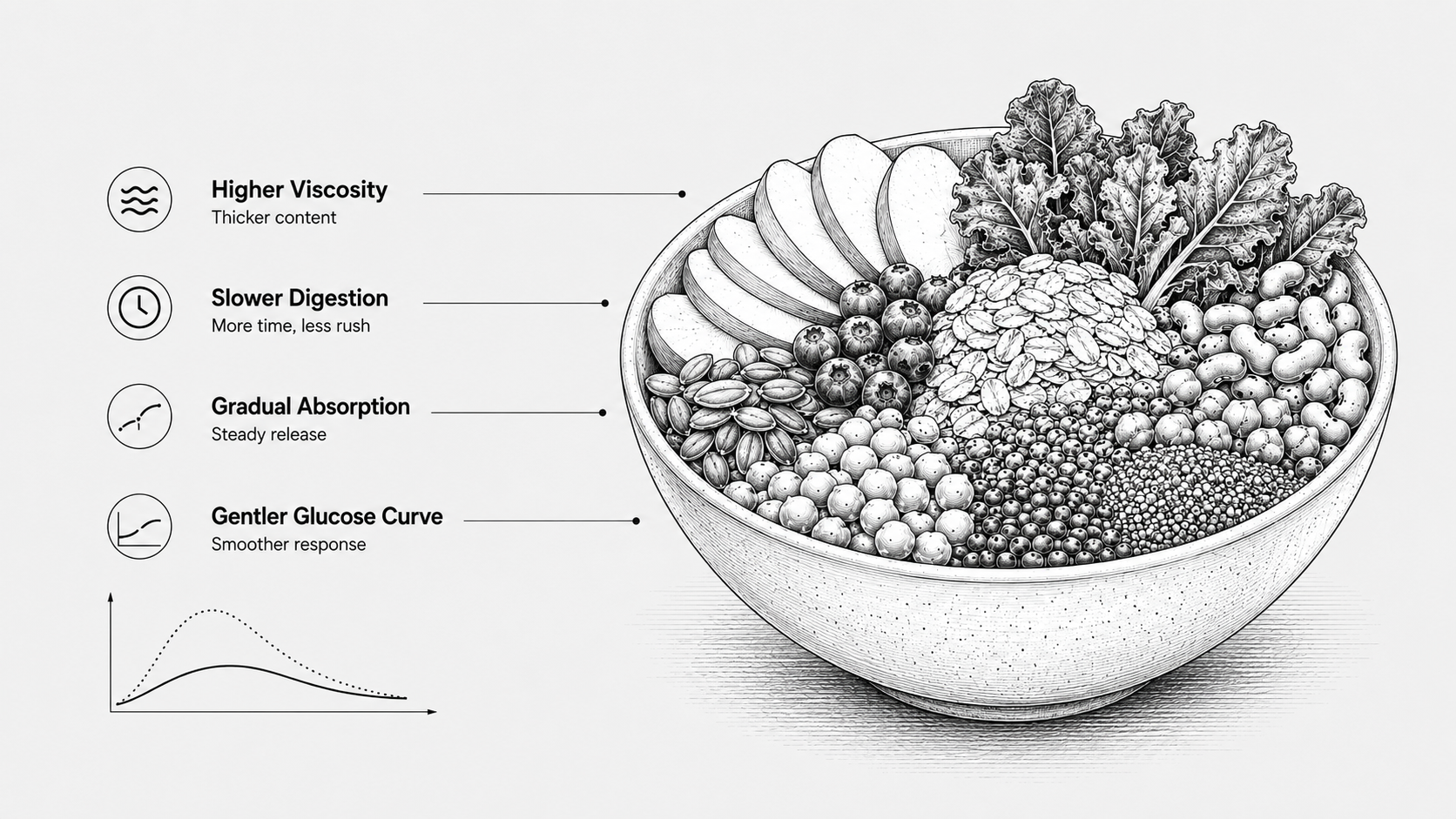
Viscous and gel-forming fibres are especially relevant to glucose because they can thicken the mixture moving through the stomach and small intestine.

That mixture is called chyme.

If chyme is thin, enzymes and nutrients can move around more easily. If chyme becomes thicker, movement slows. Enzymes may reach starch more slowly. Glucose may move toward the intestinal wall more gradually. The meal may empty from the stomach at a slower pace.

This is not a chemical trick.

It is physics.

Imagine dropping sugar into plain water. It spreads quickly.

Now imagine the same sugar inside a thicker gel-like mixture. Movement is slower. Contact is slower. Transfer is slower.

Inside the gut, that difference can matter.

Viscosity is not a marketing word. It is a mechanism.

Viscosity means resistance to flow.

Water has low viscosity. Honey has higher viscosity. A thin juice moves quickly. A thick porridge moves slowly.

When certain fibres hydrate, they increase viscosity. Psyllium is one of the strongest examples because it forms a gel when it meets water. Oats contain beta-glucan, another viscous fibre. Some gums and soluble fibres also affect viscosity, though not all fibres behave the same way.

This is important because the small intestine is where much carbohydrate absorption happens.

If the contents of the small intestine become more viscous, glucose does not move through the system in the same way. Digestive enzymes do not interact with starch in the same rapid pattern. The journey from food to blood becomes slower.

That slower journey can reduce the sharpness of the post-meal glucose rise.

The point is not that fibre cancels carbohydrates.

The point is that fibre can change how carbohydrates arrive.

Enzymes need access

Digestion is not only about what is present in the meal.

It is also about what digestive enzymes can reach.

Starch has to be broken down before it can become glucose. Enzymes such as amylase do that work.

But enzymes cannot digest what they cannot access easily.

If starch is inside intact plant cells, access is slower.

If starch is part of a dense food matrix, access is slower.

If a viscous fibre gel creates a physical barrier, access may be slower.

This is why grinding, refining, puffing, juicing, and over-processing can change the way food behaves. The more exposed the carbohydrate becomes, the easier and faster digestion can be.

A grain is not the same as flour.

A fruit is not the same as juice.

A pulse is not the same as isolated starch.

Structure changes access. Access changes speed. Speed changes response.

Whole fruit and juice are not the same food

Take a simple example: an orange.

When you eat the whole fruit, you chew. The fruit has segments, pulp, fibre, water held inside cells, and physical resistance. Eating takes time. The stomach receives a structured food.

When you drink orange juice, much of that structure is gone. The sugar and flavour remain, but the eating process becomes faster. You can drink the juice of several oranges in seconds. There is less chewing, less fibre, and less physical slowing.

This does not make fruit bad or juice evil.

It simply shows that form matters.

The same plant can behave differently depending on how it is processed.

For glucose response, the body cares deeply about form.

Rice, roti, dal, and the meal effect

No food is eaten in isolation forever.

In real life, rice is eaten with dal, vegetables, curd, pickle, ghee, papad, salad, or nothing at all. Roti may be eaten with sabzi, paneer, sprouts, chole, or sweet tea. The total meal changes the response.

This is why only asking, "Is rice good or bad?" is too simple.

Plain white rice eaten quickly in a large quantity can behave very differently from a smaller serving eaten with dal, vegetables, protein, fat, and salad. The carbohydrate may be the same food, but the meal structure is different.

Fibre from vegetables and pulses adds bulk and slows the meal. Protein and fat change digestion speed. Acidity from curd or fermented foods may also affect the meal experience. Chewing and eating pace matter too.

Glucose response belongs to the whole meal, not just one ingredient.

That is a more useful way to think.

Not "never eat rice."

Think "what is rice travelling with?"

Glycaemic index is useful, but incomplete

Glycaemic index is a measure of how quickly a carbohydrate-containing food raises blood glucose compared with a reference food.

It is useful.

But it does not explain everything.

It does not always capture real meal combinations. It does not fully account for portion size. It does not tell you how fast you eat, how the food was cooked, whether it was eaten with protein or fibre, or how your body personally responds.

Glycaemic load tries to improve this by considering both quality and quantity of carbohydrate.

Even then, the body is more complex than a table.

The practical lesson is simple: speed matters, but context controls speed.

Food form, fibre, portion, pairing, processing, and eating pace all influence the final response.

Fibre does not make sugar harmless

This point needs to be said clearly.

Adding fibre to a high-sugar food does not automatically make it healthy.

A sugary drink with a little fibre is still a sugary drink. A dessert with fibre is still a dessert. A refined snack with a fibre claim may still behave like a refined snack.

Fibre is powerful, but it is not a magic shield.

It works best as part of a better food structure, not as decoration added to poor food.

This is especially important because many packaged foods use fibre as a label advantage. They may say high fibre, but still contain large amounts of sugar, refined starch, or calories that are easy to overconsume.

The body does not care about front-pack confidence.

It responds to the actual food.

The best fibre is often inside the meal

The most natural way to improve glucose speed is not complicated.

Keep more plant structure in the meal.

Eat whole fruits more often than juices. Use dals, beans, chana, rajma, sprouts, and lentils. Add vegetables generously. Choose grains with more intact structure when possible. Include nuts and seeds where they fit. Build meals that require chewing.

This does not mean every meal has to be perfect.

It means the basic design should not leave the carbohydrate alone.

A plate of only refined starch moves differently from a plate with starch, fibre, protein, fat, water, and texture.

The goal is not to remove carbohydrates.

The goal is to slow their arrival.

Viscous fibres have a special role

All fibres are useful in their own way, but not all fibres strongly affect glucose speed.

Insoluble fibres may add bulk and support bowel function, but they may not create the same viscosity effect. Some soluble fibres dissolve but remain low-viscosity. Some fibres are mainly fermented later in the colon and may not strongly change immediate meal viscosity.

Viscous fibres are different.

They thicken. They slow. They change flow.

This is why fibres such as psyllium and beta-glucan are often discussed in relation to glucose response. Their physical behaviour inside water and chyme is central to their effect.

The mechanism is not simply that they are "natural" or "plant-based."

The mechanism is that they form a physical system.

For glucose, the physical system matters.

The small intestine is not a passive tube

The small intestine is not just a pipe where nutrients pass through.

It is a highly active sensing surface.

It receives digestive enzymes, absorbs nutrients, communicates with hormones, and sends signals that affect appetite and metabolism. When nutrients arrive quickly, the signal pattern is different. When nutrients arrive gradually, the signal pattern changes.

Viscous fibre can delay nutrient absorption and may allow more nutrients to reach further parts of the small intestine. This can influence gut hormone signalling related to satiety and insulin response.

This is one reason the glucose story overlaps with the fullness story.

A slower meal often feels more stable.

It may support fullness. It may reduce sharp hunger return. It may produce a calmer energy experience.

Again, this does not mean fibre acts like medicine in every person.

It means the gut is a sensing organ, and food structure changes what it senses.

Cooking changes carbohydrate behaviour

The same ingredient can behave differently depending on how it is cooked.

Rice cooked very soft and eaten hot may behave differently from rice that has been cooked, cooled, and reheated. Oats cooked into a thick porridge may behave differently from a sugary instant cereal. Potatoes, pasta, grains, and legumes all change structure with cooking.

Heat, water, grinding, pressure cooking, cooling, and reheating affect starch structure.

One important idea is starch gelatinisation. When starch is cooked with water, granules swell and become easier for enzymes to digest. In some foods, cooling can allow part of the starch to rearrange into resistant starch, which is less digestible.

This does not mean people need to turn meals into a laboratory.

But it helps explain why traditional food habits often work better than ultra-processed shortcuts.

Soaking, cooking, cooling, combining, fermenting, and eating with fibre-rich sides can all change the meal.

Food preparation is part of nutrition.

Eating speed also changes glucose speed

A meal eaten quickly gives the body less time to respond.

Fast eating can deliver a large amount of carbohydrate before fullness signals and digestive regulation catch up. Slower eating gives the gut more time. Chewing matters. Texture matters. Fibre-rich foods naturally slow the pace because they require more work.

This is another hidden benefit of whole foods.

They make you participate.

You cannot drink a bowl of salad. You cannot swallow chana like juice. You have to chew. That time changes the experience.

Modern foods are often engineered to remove friction. Soft, sweet, refined, and fast foods are easy to eat quickly. Fibre brings back some resistance.

Resistance is not inconvenience.

Sometimes resistance is regulation.

What a glucose-aware meal looks like

A glucose-aware meal does not have to look like a diet meal.

It can be simple.

Dal with rice and vegetables.

Roti with sabzi, curd, and salad.

Poha with peanuts, vegetables, and sprouts.

Oats with nuts, seeds, and fruit.

Chana with chopped vegetables and curd.

Idli with sambar rather than only chutney.

Fruit eaten whole rather than juiced.

The pattern is the same: do not let fast carbohydrates travel alone.

Give them fibre. Give them protein. Give them texture. Give them water held inside food. Give them a slower path.

This is not about perfection.

It is about making the normal plate behave better.

When glucose control is a medical issue

For a healthy person, this discussion is about better daily food design.

For someone with diabetes, prediabetes, insulin resistance, PCOS, metabolic syndrome, or medication use, it becomes more serious.

Fibre may help improve the glucose response to meals, but it should not be treated as a replacement for medical care. People using diabetes medicines need professional guidance because changing fibre intake, meal composition, or carbohydrate timing can affect blood sugar patterns.

Also, some fibres can affect how certain medicines are absorbed if taken too close together.

The safe principle is simple: use fibre as part of the food pattern, and involve a qualified healthcare professional when blood sugar is already a medical concern.

Fibre is not about fear. It is about rhythm.

The public conversation around glucose often becomes fearful.

Avoid this. Cut that. Never eat this. Stop all carbs.

That creates anxiety, not understanding.

A better conversation is rhythm.

How fast does food move?

How quickly does glucose appear?

How long does fullness last?

How stable does energy feel?

How much structure did the meal carry?

Fibre helps answer these questions because it changes the rhythm of digestion. It slows the rush. It gives the gut more physical structure. It makes meals behave less like a spike and more like a sequence.

That is a more mature way to think about glucose.

Not fear.

Flow.

The better question

The old question was, "Does this food contain carbs?"

The better question is, "How fast will this meal become glucose in my blood?"

That question changes the plate.

It makes fibre visible. It makes whole foods valuable. It makes food processing important. It makes meal pairing practical. It makes chewing, texture, and cooking part of the conversation.

Glucose is not just about sugar.

It is about speed.

And fibre is one of the most important ways food learns to slow down.

Final thought

The body can handle glucose.

It was designed to use glucose.

But the body was not designed around constant, fast, fibre-poor, structureless delivery of glucose all day.

That is the modern problem.

Fibre helps restore some of the original architecture of food. It adds water-holding capacity, viscosity, texture, bulk, and resistance. It asks digestion to take its time.

A slower meal is not always a smaller meal.

A slower meal is a better-behaved meal.

And sometimes, that is exactly what the body was waiting for.

Disclaimer

This article is for general nutrition education only. It is not medical advice. People with diabetes, prediabetes, hypoglycemia, kidney disease, digestive disorders, swallowing difficulty, eating disorders, pregnancy-related concerns, medication schedules, or chronic symptoms should speak with a qualified healthcare professional before making major dietary or supplement changes.