
Hunger is usually explained as a simple problem.

You ate less, so you feel hungry.

You ate more, so you feel full.

That sounds logical, but the body is not that simple. Fullness is not decided only by calories. It is also shaped by volume, texture, thickness, chewing, stomach stretch, digestion speed, water movement, and the way nutrients arrive inside the gut.

This is why two meals with similar calories can feel completely different.

A glass of fruit juice disappears quickly. A whole fruit takes longer to chew, carries fibre, holds water differently, and feels more substantial. A soft refined snack may give energy, but not much lasting fullness. A bowl of dal, vegetables, seeds, and grains may feel heavier in a good way because it gives the digestive system more structure to work with.

Fullness is not just a number on a nutrition label.

It is a physical experience.

And fibre is one of the main reasons food has that experience.

Appetite is not just willpower

Most people think appetite is psychological.

Sometimes it is. Stress, boredom, sleep, habit, emotion, and food environment all matter.

But appetite is also mechanical and chemical. The body is constantly reading what has entered the digestive tract. It senses stretch in the stomach. It senses how fast food is leaving the stomach. It senses nutrients in the small intestine. It senses the thickness of the food mixture. It senses how much work digestion will take.

This means appetite is not only about what the mind wants.

It is also about what the gut reports.

A meal that passes quickly through the stomach may not create the same satiety as a meal that has body, texture, water, protein, fat, and fibre. A drink that behaves like water is not experienced like a thick shake. A soft biscuit is not experienced like a bowl of sprouts, curd, and vegetables, even if the calorie difference is not as large as expected.

The body does not only ask, "How many calories came in?"

It also asks, "What kind of material came in?"

Texture is information

Texture is not decoration.

Texture tells the body something about food.

Crunch tells the mouth that chewing is needed. Chewing increases eating time and gives the brain more time to register the meal. Thickness tells the mouth and stomach that the food has body. Gel structure tells the gut that the contents will move differently from plain liquid. Bulk tells the intestine that there is material to process.

This is why texture matters for appetite.

Food that requires chewing often slows the eating event. Food that carries water within plant structure often feels more substantial. Food that becomes viscous in the gut can change how quickly digestion happens.

Texture is one of the ways food speaks to the body before nutrients are even fully absorbed.

A highly refined food can be calorie-dense but structurally poor. It may be easy to eat quickly, easy to swallow, and easy to overconsume. A fibre-rich food usually asks for more participation. You chew more. You drink more water. The stomach receives more volume. The gut receives more structure.

That structural difference changes the eating experience.

Fibre gives food body

Fibre is not one substance. Some fibres are coarse. Some are smooth. Some dissolve. Some swell. Some ferment. Some form gels. Some simply add bulk.

But many fibres share one important behaviour: they change how food holds water.

That single property can make food feel very different.

When fibre holds water, it can increase volume without adding the same calorie load as fat, sugar, or starch. When fibre thickens, it can make a liquid feel more like food. When fibre forms a gel, it can slow the movement of digestive contents. When fibre is present in whole foods, it gives structure to the plant material itself.

This is why an orange feels different from orange juice.

The orange has fibre, cell walls, water held inside plant tissue, and chewing resistance. Juice has sugar and flavour, but much less structure. The body receives them differently.

In simple terms, fibre helps food become more than calories.

It helps food become material.

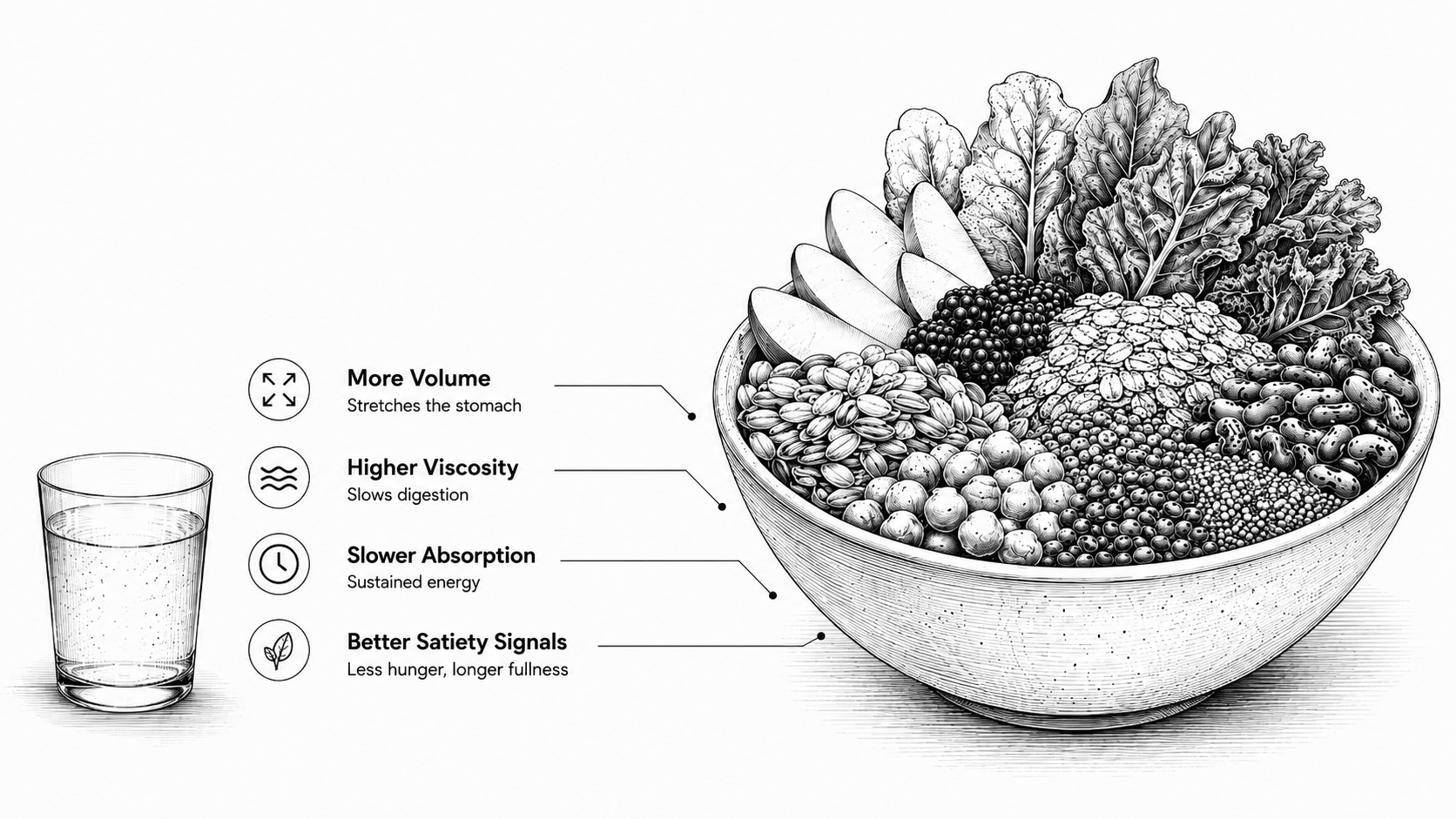
The stomach understands stretch

The stomach is not just a storage bag. It is a sensing organ.

When food enters the stomach, the stomach stretches. Stretch receptors send signals through the nervous system. These signals help the brain understand that food has arrived.

This is one reason volume matters.

A small amount of calorie-dense food can carry a lot of energy but create limited stretch. A larger volume of food with water, fibre, protein, and plant structure can create more physical presence in the stomach.

This does not mean people should try to mechanically fill the stomach without nutrition. That is not the point.

The point is that fullness is partly physical.

Fibre-rich foods often bring water and bulk with them. Vegetables, legumes, whole grains, fruits, seeds, and certain fibre ingredients can increase the physical presence of a meal. That presence helps the body register fullness more clearly.

The stomach does not read marketing claims.

It reads stretch, texture, and time.

Viscosity is the hidden part of fullness

There is a useful word in food science: viscosity.

Viscosity means resistance to flow. Water has low viscosity. Honey has higher viscosity. A thin juice flows quickly. A thick shake flows slowly.

Inside digestion, viscosity matters because food does not remain exactly as we swallow it. It becomes chyme, the semi-digested mixture of food, water, enzymes, acid, and digestive secretions.

Some fibres can increase the viscosity of this mixture.

When chyme becomes thicker, digestion can slow down. Enzymes may interact with nutrients more gradually. The movement of nutrients toward the intestinal wall can become slower. Gastric emptying may become more gradual. The small intestine may receive nutrients over a longer period.

This is one reason viscous fibres are linked with satiety.

They do not create fullness by stimulation or force. They change the physical environment in which digestion happens.

A useful way to imagine it is this: nutrients moving through a thin liquid behave differently from nutrients moving through a thicker gel-like mixture.

The body feels that difference.

Gel-forming fibres behave differently

Not every fibre creates the same fullness effect.

Some fibres add roughage but do not thicken much. Some dissolve but remain low-viscosity. Some are fermented by gut bacteria but do not create much immediate texture. Some, like psyllium, beta-glucan, and glucomannan, are known for forming viscous systems when hydrated.

Gel-forming fibres are especially interesting because they can hold water and build structure.

Psyllium is a clear example. When hydrated, it forms a gel-like network. That gel can increase the thickness of digestive contents and contribute to a feeling of fullness. This is not because psyllium is heavy in calories. It is because its physical behaviour changes the way water and food move together.

This is why fibre science cannot be reduced to grams alone.

Five grams of one fibre may behave very differently from five grams of another.

For fullness, the type of fibre matters.

The food around it matters.

The water available matters.

The speed of eating matters.

The body's tolerance matters.

Fullness is not the same as appetite suppression

There is a difference between natural fullness and forced appetite suppression.

Natural fullness is the body receiving enough signals from food: volume, nutrients, texture, stretch, digestion time, and satisfaction.

Forced appetite suppression is when hunger is treated as an enemy.

That is not a healthy way to think about eating.

Hunger is not a failure. It is a biological signal. The goal is not to silence hunger artificially. The goal is to build meals that communicate properly with the body.

Fibre helps because it makes meals more complete in structure. It can help a meal stay with you longer. It can reduce the feeling that you ate something but somehow did not eat enough.

That feeling is common after highly refined foods.

The mouth gets flavour. The body gets calories. But the gut receives very little structure.

A fibre-rich meal feels different because it gives the digestive system something to work with.

Why liquid calories often fail at fullness

Many modern calories are easy to drink.

Juices, sweetened beverages, cold coffees, flavoured milks, soft drinks, energy drinks, and many packaged drinks can deliver calories quickly. They are convenient, but they often lack structure.

A liquid that is low in fibre and low in viscosity may pass through the early digestive process quickly. It may not require chewing. It may not create the same stomach stretch as a more structured meal. It may not keep nutrients arriving gradually.

This is why liquid calories can be easy to underestimate.

You can drink them fast. They may not feel like a meal. Hunger may return sooner than expected.

This does not mean every drink is bad. It means drink structure matters.

A thin sugary drink, a protein shake, a smoothie with whole fruit, a curd-based drink, and a fibre-containing thick shake are not the same experience. Their texture, viscosity, protein content, fibre content, and digestion behaviour can be very different.

The body notices the difference even when the serving size looks similar.

Whole foods come with built-in structure

Nature usually packages calories with structure.

A chickpea is not just carbohydrate and protein. It has fibre, cell walls, starch structure, water behaviour, minerals, and texture.

An apple is not just fructose. It has pectin, skin, water held inside cells, chewing resistance, and plant tissue.

Oats are not just carbohydrates. They contain beta-glucan, starch, protein, and a structure that changes when cooked.

Vegetables are not just vitamins. They bring water, bulk, fibre, and chewing.

This built-in structure is one reason whole foods usually feel more satisfying than their refined versions.

Processing often removes structure.

Grains become flour. Fruit becomes juice. Pulses become isolated starches. Snacks become soft, fast, and easy to swallow. The food becomes easier to eat, but often less filling per calorie.

The problem is not only that modern food has more calories.

The problem is that many modern foods have fewer brakes.

Fibre is one of those brakes.

The slow meal wins

Fullness needs time.

The body does not instantly know that enough food has arrived. Signals from chewing, stomach stretch, intestinal nutrient sensing, and hormones take time to build.

This is why fast eating can defeat satiety.

A meal eaten in five minutes may be physically finished before the body has had enough time to report fullness. A meal with fibre, chewing, texture, and volume naturally slows the process. It gives the body time to catch up.

This is one of the simplest benefits of fibre-rich foods.

They often make eating less automatic.

You have to chew the salad. You have to work through the dal. You have to eat the fruit, not just drink it. You have to notice the meal.

Texture creates time.

Time helps fullness.

The small intestine also has a say

Fullness is not decided only in the stomach.

The small intestine plays a major role. When nutrients arrive in the small intestine, the body responds with signals that affect appetite, digestion speed, and insulin response. Certain hormones, including GLP-1, PYY, and CCK, are part of this signalling system.

This does not mean fibre acts like a drug.

It means the digestive tract has its own communication network, and food texture influences that network.

When viscous fibre slows digestion, nutrients may arrive more gradually. The body gets a different pattern of signals compared with a rapidly absorbed low-fibre meal. This slower pattern can support a longer feeling of satiety.

Again, the mechanism is physical before it is hormonal.

The texture changes the journey.

The journey changes the signal.

More fibre is not always better immediately

There is one mistake people often make after learning about fibre.

They increase it too quickly.

That can backfire.

A sudden jump in fibre can cause bloating, gas, heaviness, abdominal discomfort, or poor tolerance. Some fibres need more water. Some are fermented more actively. Some thicken quickly. Some may not suit a person's digestive condition.

Fibre works best when the body is allowed to adapt.

A better approach is gradual. Add fibre-rich foods consistently. Increase water intake. Notice tolerance. Pay attention to the type of fibre. Do not expect every fibre to feel the same.

Fullness should feel comfortable, not forced.

The right fibre pattern should make meals feel more complete, not make the body feel overloaded.

Building meals that feel complete

A filling meal usually has more than one satiety signal.

It has protein for repair and metabolic signalling.

It has fibre for structure and gut function.

It has water held inside food, not just water beside food.

It has some healthy fat for flavour and slower digestion.

It has texture that requires chewing.

It has enough volume to be noticed by the stomach.

This is why simple traditional meals often work well.

Dal, sabzi, curd, salad, millets, rice, roti, sprouts, fruits, nuts, and seeds can be arranged in many ways. When balanced well, they create fullness through structure, not just quantity.

A satisfying meal is not always a large meal.

It is a well-designed meal.

The better way to understand fullness

The old way of thinking was simple: eat fewer calories and tolerate hunger.

The better way is more intelligent: build meals that help the body feel fed.

Fibre matters because it changes food from something that only delivers energy into something that carries structure. It helps food hold water. It can create thickness. It can slow movement. It can increase chewing. It can support a longer digestive experience.

This is why texture changes appetite.

Not because the mouth is fooled.

Because the body is informed.

Fullness is not only about how much food enters the body.

It is about how that food behaves once it gets there.

Final thought

Fibre should not be respected only because it helps with regularity.

It should be respected because it changes the physical language of food.

A low-fibre meal may be rich in taste and calories, but poor in structure. A fibre-rich meal gives the gut more information. It has volume, texture, water, resistance, and time built into it.

That is what fullness often needs.

Not tricks.

Not force.

Not fear of hunger.

Just better food structure, repeated daily.

Disclaimer

This article is for general nutrition education only. It is not medical advice. People with diabetes, digestive disorders, swallowing difficulty, kidney disease, eating disorders, medication schedules, pregnancy-related concerns, or chronic symptoms should speak with a qualified healthcare professional before making major dietary or supplement changes.