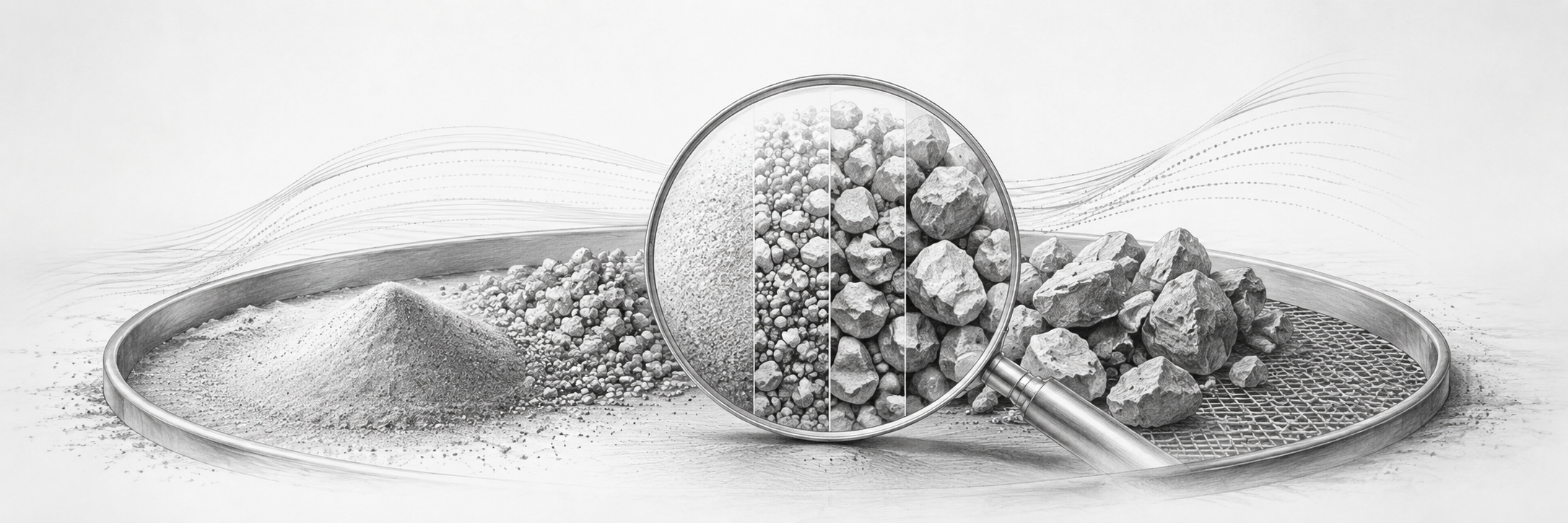
Agglomeration
Fine particles are assembled into larger, more porous granules so water can move through spaces in the particle structure.

Psyllium technology
Instantised psyllium, also written internationally as instantized psyllium, is designed around a better sequence: wet, disperse, hydrate, then build viscosity.
Instant psyllium sounds contradictory because psyllium is naturally known for absorbing water, swelling and thickening.
That behaviour is not a defect. The problem is the sequence. If hydration begins before the powder has spread through the drink, the outside of a particle cluster can turn into gel while the inside remains dry.
If the particles disperse first and hydrate afterwards, the same psyllium can give a more manageable preparation experience. Instantised psyllium does not promise instant dissolution. It means faster, more uniform dispersion.
The international search term instantized psyllium describes the same intended performance. Fybrance uses the British spelling in editorial copy while recognising both terms in technical and commercial conversations.
First principle
Searches such as how to dissolve psyllium husk are common because dissolution is how people usually judge a drink powder. Sugar and salt dissolve. Psyllium behaves differently.
Psyllium hydrates, swells and forms a suspension that can develop into a gel. A good instant psyllium should not be judged by whether the glass becomes clear. The useful question is whether the fibre distributed evenly without creating stubborn dry-cored lumps.
That is a dispersion problem, and dispersion can be engineered.
Instantised psyllium is engineered to disperse before it gels.
The sequence problem
Psyllium contains mucilage that begins interacting with water as soon as it becomes wet. Imagine dropping a spoonful of fine powder onto the surface of a glass. The particles arrive packed close together.
Water reaches the exposed particles first. Their surfaces hydrate and become sticky. A gel layer then forms around neighbouring dry particles. The centre of the cluster is protected from fresh water by the very gel the psyllium has just created.
From the outside the lump looks hydrated. Break it open and there may still be dry powder inside. Instantisation tries to give water and psyllium a better introduction before that barrier forms.
Particle engineering
There is no single process that automatically defines instantised psyllium. It is better understood as a functional grade designed around rapid wetting and dispersion.
Fine particles are assembled into larger, more porous granules so water can move through spaces in the particle structure.
A food-grade coating can modify initial wetting and reduce the tendency of neighbouring particles to lock together immediately.
The profile balances mouthfeel against hydration speed instead of treating the finest possible mesh as automatically preferable.
Bulk density and internal structure affect whether particles float, sink, wet, spread or remain concentrated at the surface.
Reducing uncontrolled fine dust can improve handling and prevent a compact cloud of powder entering the water together.
Acids, sweeteners, flavours, minerals, proteins and other fibres can all change the behaviour of the final powder.
Controlled structure
Agglomeration sounds as if it should make clumping worse. In powder technology, controlled agglomeration and uncontrolled clumping are very different events.
Uncontrolled clumping happens in the glass. Controlled agglomeration happens during manufacturing. Fine particles are deliberately assembled into structured granules with a chosen size, porosity, density and breakdown behaviour.
The resulting powder may be physically larger than fine psyllium powder but easier for water to penetrate and distribute. Instant coffee, dairy powders and proteins use the same broad powder-engineering principle. Psyllium presents a more difficult version because viscosity begins developing as hydration proceeds.
Mesh is not performance
Fine psyllium can give a smoother mouthfeel than visibly coarse husk and may remain suspended more readily. Reducing particle size also increases the amount of surface exposed to water.
More surface can mean faster hydration. Faster hydration can mean less time to distribute the powder before viscosity rises. There is no universal rule that finer psyllium equals better psyllium.
The right particle profile depends on what happens after the scoop reaches the glass. Instantisation looks at the complete preparation sequence rather than mesh in isolation.
The target sequence
The goal is not to stop hydration indefinitely. It is to improve the order of events while keeping psyllium recognisably psyllium.
Designed sequence
Clumping sequence
Compare
| Property | Conventional fine psyllium | Well-designed instantised psyllium |
|---|---|---|
| Initial wetting | Can be highly uneven | Designed for more uniform wetting |
| Fine-powder dusting | Can be noticeable | Agglomeration may reduce fines |
| Clumping | Strongly dependent on technique | Designed to reduce lump formation |
| Spoon mixing | Can require immediate vigorous stirring | Targeted for easier preparation |
| Particle structure | Natural or milled | Engineered |
| Gel formation | Yes | Yes |
| Dissolves like sugar | No | No |
| Main specification | Often purity and mesh | Performance, composition and particle properties |
Test method
Calling a psyllium powder instant is easy. Demonstrating it requires a repeatable preparation method with a defined powder weight, water volume, temperature, vessel and mixing action.
Record how long dry material remains visible at the surface and how quickly water enters the powder.
Count or weigh dry-cored lumps after a defined spoon-stir or shaker method.
Observe distribution after a fixed number of stirs or seconds of shaking.
Measure thickness after 30 seconds, 60 seconds and several minutes, not only at one late time point.
Track size distribution, bulk density, flowability, porosity and dust alongside composition.
Review suspension, grittiness, mouthfeel and the practical time available for drinking.
A useful distinction
An instant psyllium may be coated and agglomerated. Another system may rely more on particle distribution, density or selected formulation components. The correct route follows the application and the test target.
Read how psyllium coating worksApplication fit
The commercial value is not the presence of an extra processing step. It is a more usable preparation experience in formats people are expected to make quickly.
Routine products where easier spoon stirring can decide whether preparation becomes a habit.
Fixed servings that need to work in an ordinary glass across repeat consumer preparation.
Products where flavour, sweetener and acid systems can interact with hydration and viscosity.
Systems that need dispersion without depending on a high proportion of crystalline sugar.
Mixed matrices where psyllium must coexist with proteins, minerals and other functional ingredients.
Customer-specific instantized psyllium products defined by a target preparation method and market brief.
India origin
India is already deeply associated with psyllium. The next opportunity is not only to export more husk. It is to export more functionality per kilogram.
Controlled particle profiles, improved microbial grades, application-specific systems, coated psyllium, agglomerated psyllium and instantised psyllium can move the conversation from commodity supply towards material performance.
For an international buyer searching for an instantized psyllium supplier in India, a useful specification goes beyond purity and price. It asks how quickly the powder wets, how dispersion is tested, how many lumps remain, how fast viscosity rises and whether that behaviour is consistent from batch to batch.
Development brief
Fybrance is not interested in making psyllium look more processed simply for differentiation. The target is practical: better dispersion, less clumping, predictable hydration and a more repeatable preparation experience while keeping psyllium recognisably psyllium.
That requires raw-material quality, particle engineering and application testing to work together. A B2B brief should include the psyllium percentage, target serving, liquid volume, mixing method, desired drinking window, sweetness system, flavour system, fibre claim, market, packaging format and acceptable supporting ingredients.
From there, the right route can be evaluated and measured. Words such as instant, easy mix and rapidly dispersible should point to a test method rather than remain adjectives on a sales sheet.
Technical enquiry
Share the serving, water volume, mixing method, desired drinking window, supporting ingredients, market and the performance result you need to measure.
Discuss an instantised psyllium requirementCommon questions
Instant psyllium is psyllium that has been processed or formulated to wet and disperse more readily in liquid than conventional untreated psyllium.
No. Instant refers to improved preparation and dispersion. Psyllium remains a gel-forming fibre.
Yes. Instantised is the British spelling and instantized the American spelling. Fybrance uses instantised editorially while recognising both search terms.
No. Agglomeration is a processing technique. Whether the finished material deserves an instant or rapidly dispersible description depends on measured performance.
Yes. Psyllium naturally develops viscosity as it hydrates. Instantisation is intended primarily to improve what happens before and during that hydration.
Not automatically. Fine particles may reduce grittiness but can hydrate very rapidly. Particle size, coating, agglomeration, density, water level and formulation all influence dispersion.
Yes. Instantisation concerns the behaviour of the powder rather than its flavour. Flavoured and unflavoured systems are both possible.
Do not make that assumption. Easier dispersion does not remove the need for adequate liquid. Finished-product directions should define the appropriate amount of water.
Evidence and technical reading