Initial wetting
A surface treatment can help water contact the powder more evenly during the first seconds of mixing.

Psyllium technology
A food-grade surface treatment can change the first seconds of contact between psyllium and water, helping particles wet and separate before a gel-coated lump develops.
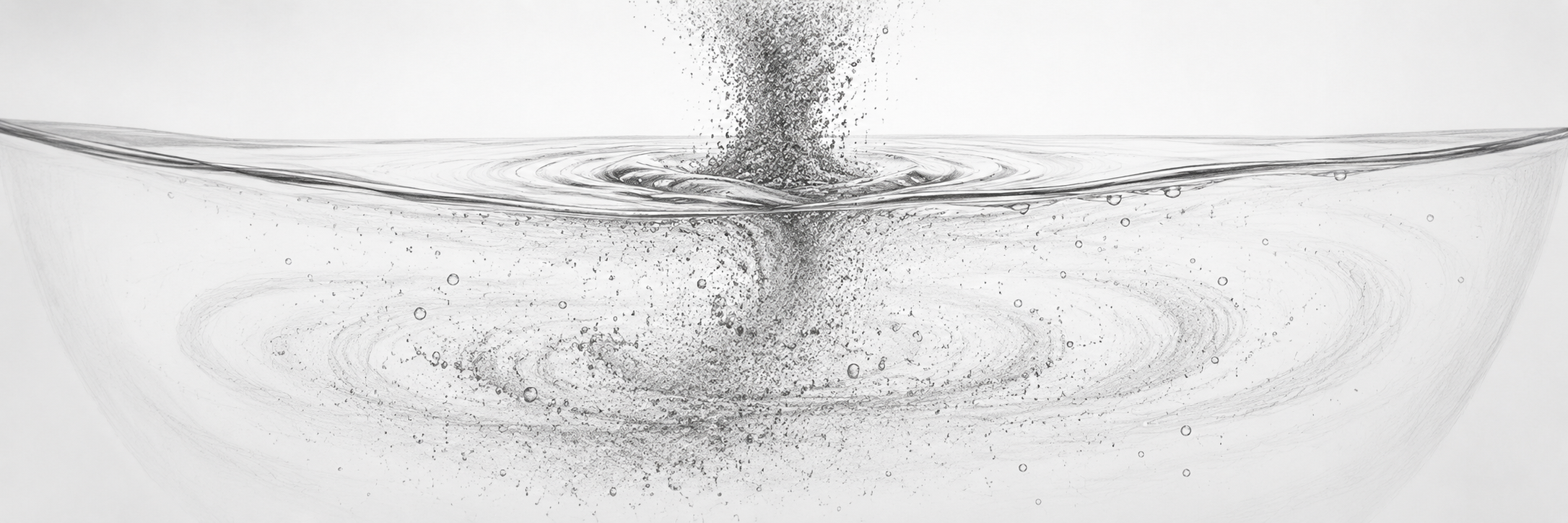
The property that makes psyllium useful is also the property that can make it frustrating to prepare.
Psyllium husk takes up water rapidly and forms a viscous mucilage. When thousands of dry particles meet water together, some surfaces hydrate before the powder has spread through the liquid. Those wet particles can attach to their neighbours and build a soft gel around a dry centre.
The familiar result is a floating lump that looks wet outside but still contains dry psyllium. Coated psyllium approaches this problem at the particle surface. The aim is not to make Plantago ovata husk soluble. It is to help the particles disperse before full hydration dominates the preparation.
That first window matters. It can determine whether a fibre drink becomes evenly suspended or leaves the user chasing dry-cored islands around the glass.
The preparation problem
Drop ordinary psyllium into water and several events begin almost together. Water reaches the husk surface, mucilage starts hydrating, each particle begins to swell and neighbouring wet particles become more likely to stick.
Once a hydrated layer surrounds a cluster, fresh water has difficulty reaching the dry material inside it. More stirring may deform the outside of the lump without opening the dry centre because the surface has already become a soft gel.
This distinction is important. The lump is not simply undissolved psyllium. Psyllium is not meant to disappear like sugar. It is poorly dispersed psyllium, and dispersion is a different technical problem from dissolution.
A useful preparation system therefore focuses on wetting, particle separation and controlled hydration. It keeps the natural gel-forming character of the fibre while improving the order in which the early events happen.
Coating does not make psyllium soluble. It gives the powder a better opportunity to disperse before the gel becomes dominant.
Surface treatment
Coated psyllium is psyllium whose particles have received a thin food-grade surface treatment. There is no single universal coating formula. The material and process have to be selected around the behaviour required in the finished system.
Historical work has explored water-dispersible carbohydrate systems, edible-acid-containing coatings, hydrocolloids and gum arabic, which is also called acacia gum. The purpose is not simply to add another ingredient. It is to change what happens at the interface between the dry husk and water.
A well-designed surface can encourage more uniform wetting, help nearby particles remain separated during initial mixing and give water time to distribute through the powder before large gel-coated aggregates form.
Performance still depends on the starting psyllium grade, particle-size distribution, coating identity, coating level, moisture, bulk density and surrounding formulation. Coated psyllium husk should therefore be treated as a performance specification, not only as an ingredient name.
Measured outcomes
A coating system can influence several parts of preparation and powder handling. Each result should be demonstrated with a defined test rather than assumed from the process name.
A surface treatment can help water contact the powder more evenly during the first seconds of mixing.
Particles can be given more opportunity to spread through the liquid before they become locked into a hydrated cluster.
An effective system can reduce dry-cored lumps under a stated spoon-stir or shaker-bottle method.
A controlled particle system can make the drinking window and viscosity development more repeatable.
Some systems may also influence dust, flow, storage behaviour or compatibility with other dry ingredients.
Better particle-level control can reduce dependence on large amounts of sugar or granular carrier simply to keep psyllium apart.
Compare
| Property | Conventional psyllium | Coated psyllium |
|---|---|---|
| Initial water contact | The natural husk surface contacts water directly | The initial surface interaction has been engineered |
| Wetting | Can be uneven | Can be designed for more uniform wetting |
| Clump formation | Strongly dependent on mixing technique | Can be reduced by an effective coating system |
| Dispersion | Depends heavily on particle size and agitation | Can be designed around a defined dispersion target |
| Gel formation | Yes | Yes |
| Becomes soluble | No | No |
| Formulation control | Mainly through the surrounding recipe | Adds particle-level control |
| Performance basis | Raw grade and preparation method | Raw grade, coating, process and preparation method |
A useful example
Acacia gum is one material that has been investigated for coating psyllium. From a formulation perspective, it is interesting because it disperses readily in water, has relatively low viscosity at useful processing concentrations and can act as a film-forming material.
Historical work with gum-arabic-coated psyllium showed that surface treatment, combined with control of particle size, moisture and bulk density, could produce rapidly dispersible psyllium powder. This is prior art from other organisations, not Fybrance technology or Fybrance intellectual property.
Acacia is not the only possible route. Its value here is that it demonstrates a broader principle: the surface chemistry of psyllium can be engineered without removing the underlying fibre or its eventual gel-forming behaviour.
Related, not identical
An instantised psyllium system may use coating, agglomeration, controlled particle-size distribution, density engineering or a combination. A coated psyllium can be one route towards an instantised system, but a coating alone does not guarantee excellent instant performance.
Explore how instantised psyllium worksParticle balance
Grinding psyllium finer can improve mouthfeel because the particles feel less coarse. The trade-off is surface area. More exposed surface can allow very rapid hydration, giving the powder less time to separate before viscosity rises.
A formulator can therefore exchange one problem for another: less grit, but faster clumping and a shorter drinking window. Good coated psyllium powder design considers particle size together with wetting, coating, agglomeration, water volume, mixing method and the time available for consumption.
Mesh is useful information, but mesh alone does not define psyllium dispersibility.
Application fit
Coated psyllium is most relevant where the product experience depends on predictable contact between the fibre and liquid. The specification should follow the preparation method.
Spoon-stirred or shaker-prepared products where lump reduction and a predictable drinking window matter.
Measured portions that need consistent wetting in an ordinary glass with limited mixing equipment.
Formulations that cannot depend on a large granular sugar phase to separate psyllium particles.
Dry blends where proteins, minerals, flavours and other fibres can change hydration and viscosity.
Customer-specific products with defined mixing directions, sensory targets and documentation needs.
B2B systems where dispersion behaviour must be designed around the final matrix rather than the ingredient in isolation.
Development brief
Fybrance does not believe a coated psyllium ingredient should be specified only by purity and mesh. A useful development brief starts with the finished application, the liquid, the mixing method and the preparation experience that needs to be improved.
The technical review can then consider botanical identity, husk purity, particle-size distribution, coating identity, coating level, moisture, bulk density, flow, wetting behaviour, dispersion time, lump formation, suspension and the viscosity curve after mixing.
Microbiological quality, contaminants, residues, allergens, processing history and documentation remain equally important. Easier mixing is not a substitute for a disciplined starting material.
The goal is not to engineer psyllium so aggressively that it stops behaving like psyllium. The goal is to make good psyllium easier to use.
India origin
India sits at the centre of the global Plantago ovata supply chain. That creates an opportunity to move beyond exporting conventional husk and powder alone.
Controlled-mesh, coated and instantised grades can add application value closer to the agricultural source. Fybrance works from that perspective: connect India-origin psyllium with clearer specifications, measurable behaviour and the requirements of the finished product.
For B2B coated psyllium sourcing, development or private-label enquiries, the conversation should begin with the required dispersion behaviour rather than only a price per kilogram.
Technical enquiry
Share the target format, psyllium level, water volume, mixing method, market, supporting ingredients and the preparation problem you want to solve.
Discuss a coated psyllium requirementCommon questions
No. Psyllium is a gel-forming fibre rather than a conventional soluble powder like sugar. Coating is intended to improve wetting and dispersion, not make psyllium disappear into water.
Yes. A coating can modify the initial interaction with water, but psyllium should retain its fundamental hydration and gel-forming behaviour.
Not necessarily. Coating is one processing approach. Instantisation is a broader performance objective that can involve coating, agglomeration, particle engineering or combinations of these.
Acacia, also called gum arabic, has historically been used as a film-forming coating in rapidly dispersible psyllium systems. Other food-grade coating approaches also exist.
Fine grinding may reduce grittiness but increases the surface area available for rapid hydration. Coating and agglomeration provide additional ways to control how particles initially interact with water.
Absolutely. Improved dispersion does not remove the water requirement. Psyllium should never be consumed dry, and the directions and water quantity on the finished product should always be followed.
Evidence and technical reading